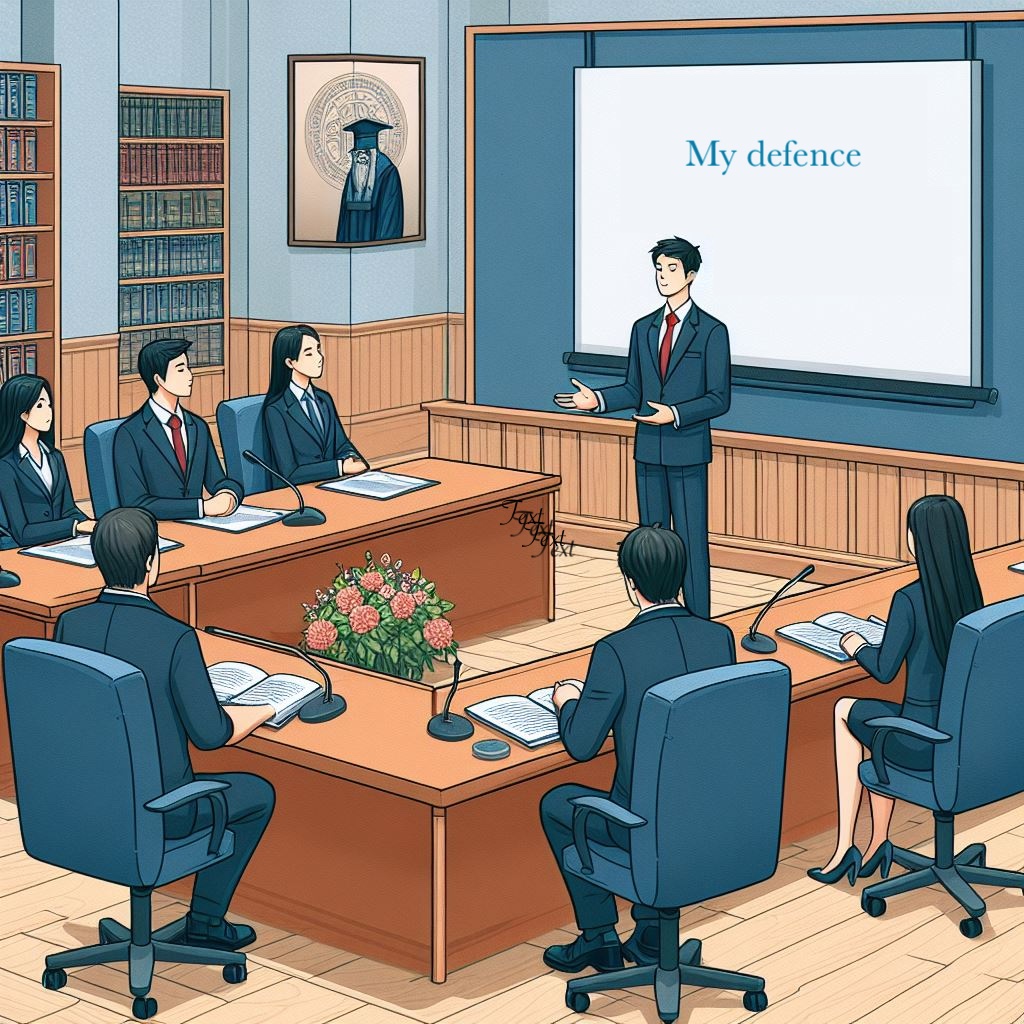
Very important! The submitted thesis itself is evaluated by the opponent and the commission, as the thesis is shown to the public; the submitted thesis cannot be changed after submission. Thus, it is not (solely) the presentation during the defence, which is evaluated. Also, not only the quality of the laboratory work is evaluated by the file of thesis - so, the written text, the pictures, figures etc. in the thesis.
Bachelor state exams and defences
- state exam - oral examination. Students draw a question (or questions, depending on the exam) and then have 30 minutes to talk about it. If you need, you can take some of this time for preparation; however, this time is counted into the limit of 30 minutes. Paper sheets or a table will be available if you want to draw something. You will have at least 30 minutes between the exams, if possible. State exams usually start at 8 am until late afternoon, depending on the number of students. Immediately after the exam, it is announced if the student passed; complete results, including the grades, are usually announced afternoon (depending on the number of students) or the next day in person or by mail. In exceptional cases, you can ask for a written exam. A set of questions for the state exams is available online.
- defence - 45 minutes are reserved for one student. You will have a maximum of 12 minutes for your presentation. Please be sure not to exceed this time. The evaluation by the supervisor and the opponent are presented after your presentation. Next, you answer the question(s) of the opponent (the answers can be included at the end of the presentation, after the "Thank you" slide). Lastly, you will answer the questions from the commission and the guests. Next, everyone except the commission members (including the supervisor) leaves, and the commission discusses the thesis and votes on the grade. The result is announced immediately after the defence.
Master state exams and defences
- defence is usually the first - 60 minutes reserved for one student. You will have a maximum of 12 minutes for your presentation. Please be sure not to exceed this time. The evaluation by the supervisor and the opponents are read after your presentation. Next, you answer the opponents' questions (the answers can be included in the presentation after the "Thank you" slide). Lastly, you will answer the questions from the commission and the guests. Next, everyone except the commission members (including the supervisor) leaves, and the commission discusses the thesis and votes on the grade. The result is announced immediately after the defence.
- state exam - usually after the defence - oral, approximately 15 minutes per subject (3 subjects).
Students working on their MSc thesis in Linz - you must submit the assignment of the Master's thesis also at USB (not only at JKU), and you must apply for the state exam and defence also at USB (even though you do it at JKU), and you must submit your thesis before the defence also at USB.
BSc Biological Chemistry state exam (for the most current curriculum) - you must choose:
mandatory:
Biochemistry - contents of the courses Biochemistry 1. Biochemistry 2. Biochemistry Laboratory 1. Biochemistry Laboratory 2
Cellular and Molecular Biology - contents of the courses Methods in Molecular Biology. Cellular and Molecular Biology and Genetics I
+ one from:
Biology of Plants - contents of the courses Plant diversity and ecology, Plant Biochemistry
Biology of Animals - contents of the courses Biology of Animals, Animal Physiology
Biology of Microorganisms - contents of the courses Biology of Microorganisms, Environmental, medical and technological aspects of microbiology
Biomedicine - contents of the courses Clinical Biochemistry, Introduction into Biomedicine, Biopharmacy
Omics in Systems Biology - contents of the courses Introduction to Bioinformatics. Omics in Systems Biology
MSc Biological Chemistry state exam (for the most current curriculum) - you must choose:
1. UCH/SN11 Advanced Biology and Biochemistry - covers UCH/020 Gene and Protein Engineering, UCH/013E Principles and Techniques in Biochemistry and Molecular Biology, UCH/060 Computational Chemistry and Molecular Modelling of Biomolecules and UCH/784 Cellular and Molecular Biology 2 + select one module, every module covers the listed courses:
- Biological Elective: Advances in Biological Systems – lectures UCH/045 Glycobiochemistry, KMB/217 Methods of Functional Genomics, KME/723 Immunology, and UCH/052 Xenobiochemistry and Toxicology;
- Biological Elective: Molecular and Developmental Biology – lectures KMB/614 Cell Regulation and Signaling, KPA/604 Molecular Phylogenetics, KMB/759 Genetics the Molecular Approach, and KMB/618 Epigenetics and regulation of gene expression;
- Biological Elective: Structural Biology Techniques – lectures UCH/027 X-Ray Crystallography, UCH/651 Optical Methods in Biochemistry, UFY/EM1 Electron Microscopy I and UFY/EM2 Electron Microscopy II;
2. UCH/SN36 General Chemistry, select a subject:
- Fundamentals of Chemistry and Technology for Biological Chemists
- Fundamentals of Chemistry and Technology for Technical Chemists
3. UCH/SN12 Biological Chemistry Masters Elective, select one of mandatory or mandatory elective courses, which is not covered in the module selected in UCH/SN11 and is related to your thesis, e.g.: Gene and Protein Engineering, Electron Microscopy, X-ray Crystalography, Computational Chemistry, Glycobiochemistry, Xenobiochemistry, Immunology, Molecular Phylogeny.
Do not forget to APPLY for the state exams or the defence (or both at the same term) within the deadline.
You should get the supervisor's and the opponent's review at least three days before the defence - they should be uploaded to the STAG and sent to you as well.
You can check what are the supervisor and the opponent evaluating to give you some hints, in addition to the requirements and recommendation on writing theses:
Requirements and recommendations for writing theses at the Dept. of Chemistry
The course of the defence
Usually the defence of BSc and MSc theses looks like this:
1) the head of the commission welcomes and introduces the student, the commission, and the audience.
2) student presents the presentation/defends her/his thesis, usually finishing with the "Thank you" slide
3) supervisor presents her/his review
4) the opponent (or two in the case of MSc theses) presents her/his review
5) student answers the questions and comments of the opponent. For MSc theses defences, student can answer first the questions and comments of the first opponent, then the 2nd opponent presents her/his review and students answers those questions and comments
6) all commission members can ask any question and student answers
7) audience can ask
8) everybody except the commission leaves and the commission discusses and votes on the grade
9) the grade is announced
Questions and comments in the opponent's review
You can include the answers to the questions and comments after the "Thank you" slide
Dresscode
You should wear a formal or business casual dress for the defence
Graduation ceremony
You should wear a formal or business casual dress for the defence; similarly your invited guests should be formally dressed. The audience is guided on when to stand or sit; everybody stands during the national and EU anthems.