
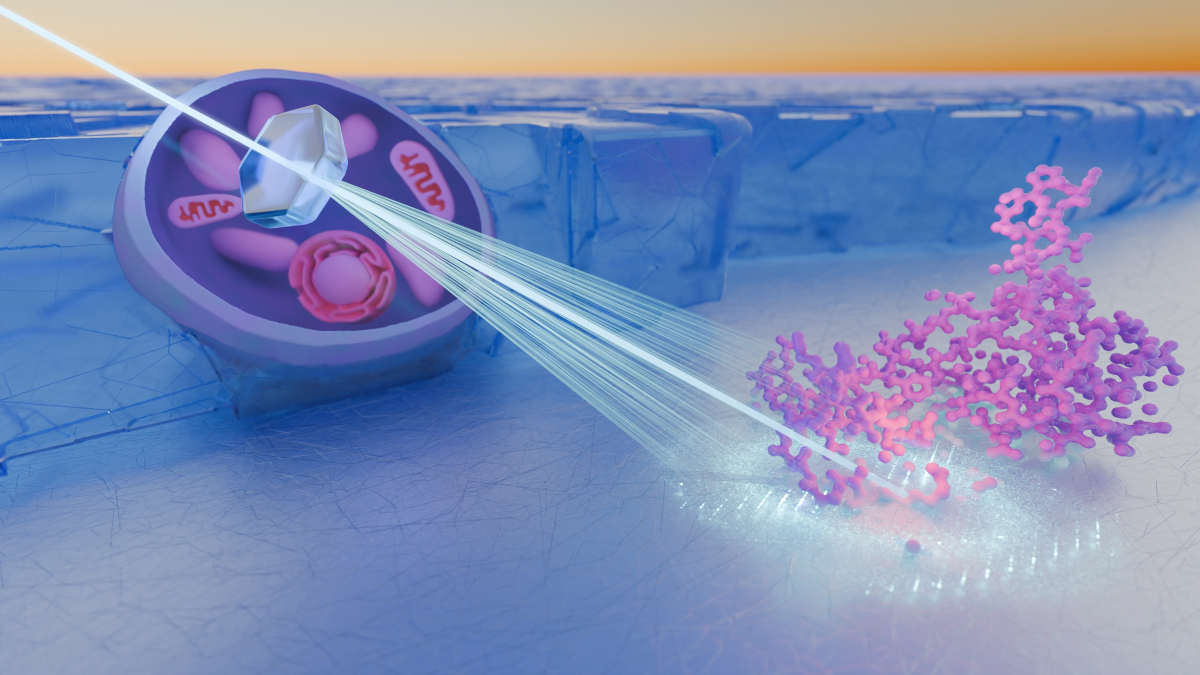
Scientists from the Faculty of Science at the University of South Bohemia have made a groundbreaking achievement in structural biology by determining a high-resolution protein structure from a single crystal grown inside a living cell. This was achieved in collaboration with experts from the Institute of Molecular Genetics (CAS, Prague), ELI Beamlines (Prague), Biology Centre CAS (České Budějovice), University of Lübeck (Germany), and Uppsala University (Sweden).
The newly developed method, IncelluloED, combines intracellular protein crystallization with in-situ three-dimensional electron diffraction using standard cryo-electron microscopy (cryo-EM) equipment. It paves way for high-resolution structural analysis performed directly in cells and bypassing laborious protein purification and in vitro crystallization.
Intracellular crystallization has emerged as a promising strategy in structural biology, but the existing approaches faced major limitations. In 2024, the InCellCryst pipeline was introduced by our collaborators from the University of Lübeck for studying intracellular crystals using serial X-ray crystallography. However, serial crystallography requires the exposure of tens of thousands of crystal-containing cells, which prevents high-resolution studies on proteins that crystallize in only a few cells. IncelluloED breaks this barrier by enabling structure determination from just a single crystal in one cell.
The performance of the IncelluloED method was demonstrated using a microcrystal of HEX-1 protein from a rice blast fungus (Magnaporthe grisea) grown in an insect cell. While the IncelluloED yielded a 1.9 Å resolution structure from a 1.6 µm³ crystal, the serial X-ray crystallography required thousands of crystals with a total volume over 11 million µm³ to reach similar atomic resolution. IncelluloED showcased a multimillion-fold reduction in required material for high resolution structure determination.
Beyond its immediate performance, IncelluloED opens new avenues for systematic studies of intracellular crystallization, such as crystallization frequency and diffraction quality, and allows to search for ordered nanodomains within larger, poorly diffracting crystals. Future enhancements, like co-crystallization with ligands naturally occurring in cells, could boost structure-based drug discovery.
Despite its overall complexity the workflow proved robust: All cell that were selected for analysis yielded diffracting crystals and no sample was lost. By requiring only, a single crystal inside a single cell and using standard cryo-EM platforms, IncelluloED brings high-resolution structural biology into conventional laboratory settings and represents a significant step toward a new paradigm in the field, the realization of a single-cell structural biology laboratory.
Štěpánka Bílá, Dominik Pinkas, Krishna Khakurel, Juliane Boger, Tomáš Bílý, Janos Hajdu, Zdeněk Franta, Iñaki de Diego Martinez, Roman Tuma, Lars Redecke and Vitaly Polovinkin: Single-Cell Structural Biology with Intracellular Electron Crystallography, Nat Commun (2026). https://doi.org/10.1038/s41467-026-69205-6


