
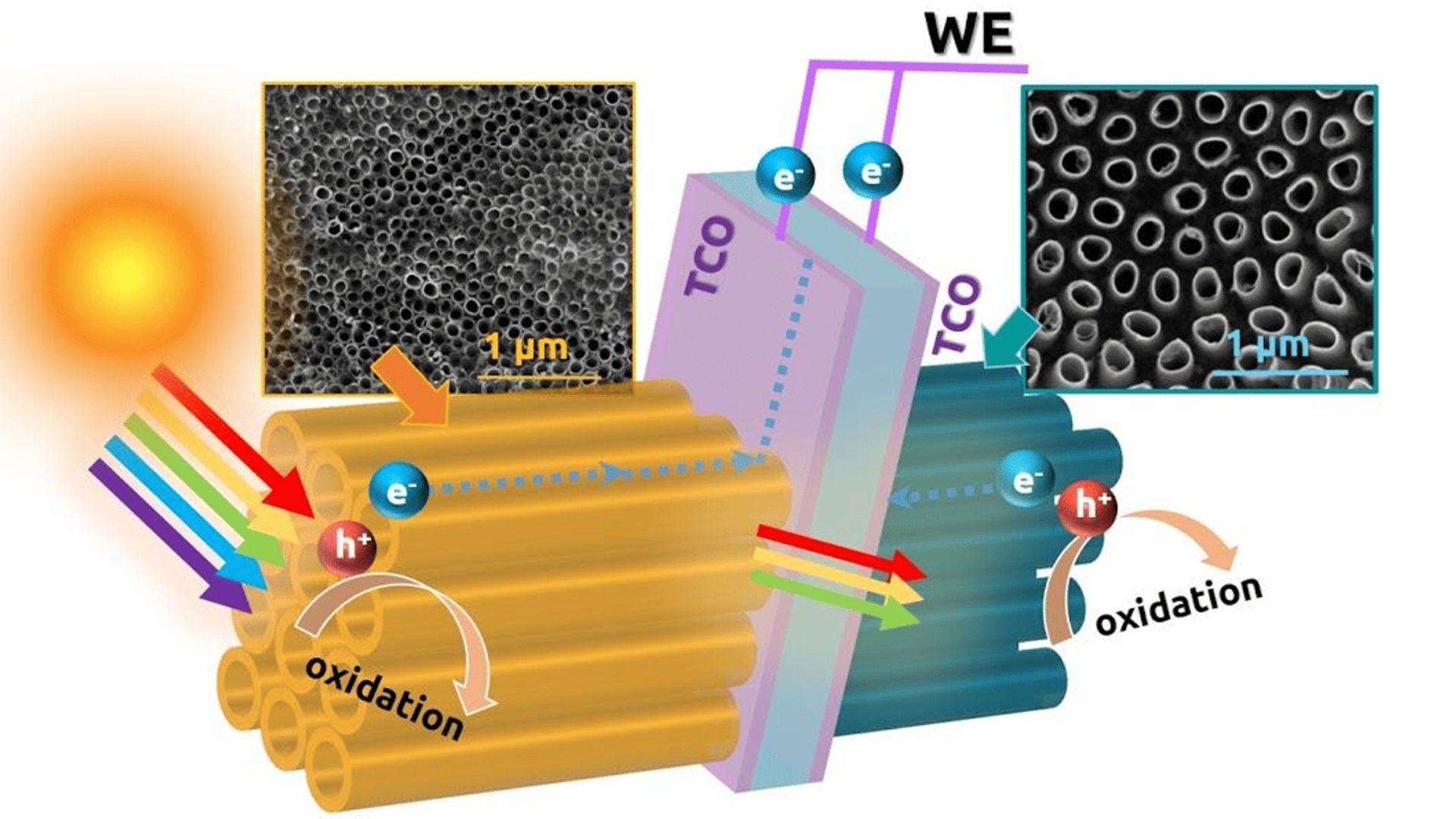
The international Czech–Polish GA CR project “Nanostructured Surfaces with Enhanced Photoconversion” (21-05030K), led by Prof. Vítězslav Straňák from the Laboratory of Plasma Physics and Nanostructures at the Department of Physics, Faculty of Science, University of South Bohemia, has received the highest possible rating, Excellent, in its final evaluation by the Czech Science Foundation (GA CR).
The project focused on the development of advanced nanostructured materials for more efficient utilization of light energy. In the context of growing demands for sustainable energy technologies, improving photoconversion efficiency represents one of the key challenges in modern materials science. The research consortium successfully designed, fabricated, and experimentally validated novel nanostructured semiconductor surfaces based on TiO₂ nanotube arrays, demonstrating significantly enhanced light-harvesting capability and photon-to-electron conversion efficiency. The knowledge generated within the project provides a foundation for future developments in photoelectrochemical systems, renewable energy technologies, and advanced optical and electrochemical sensing platforms.
The project brought together research teams from the University of South Bohemia, Charles University, Warsaw University of Technology, and the Institute of Fluid-Flow Machinery of the Polish Academy of Sciences. The combination of expertise in plasma technologies, nanostructure fabrication, anodization processes, optical fiber sensors, and advanced material characterization enabled research that would not have been achievable within a single institution. Among the most significant outcomes of the project were the development of double-sided semitransparent photoelectrodes based on tailored TiO₂ nanotube architectures and the design of TiO₂/MXene heterostructures with substantially improved photoelectrochemical performance. These results were published in the high-impact journals Renewable and Sustainable Energy Reviews and ACS Nano. The published studies demonstrated that a precisely engineered nanostructure can significantly enhance light utilization efficiency, while the TiO₂/MXene heterostructures achieved up to a tenfold increase in photoconversion efficiency compared with reference systems.
The project outcomes were summarized in 13 scientific papers indexed in the Web of Science database, including nine publications in first-quartile (Q1) journals and four in first-decile (D1) journals. In addition, the project established new international research partnerships that have already resulted in follow-up collaborative projects and further expansion of cooperation in the fields of advanced nanomaterials, photoconversion, and sensing technologies.


