
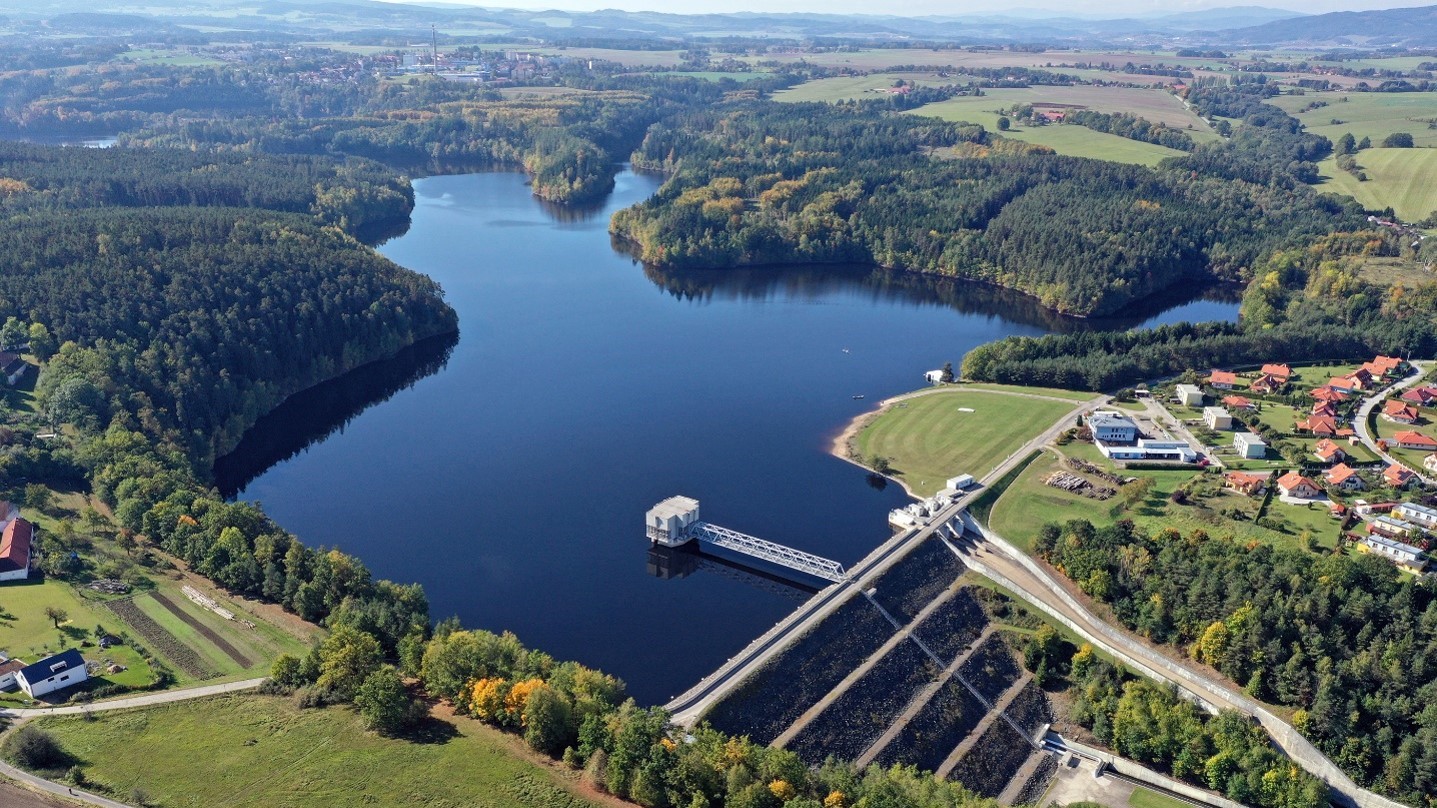

Reservoirs are not only important sources of drinking water, but also active ecosystems where greenhouse gases are produced, transformed, and released. One of the most important of these gases is methane, which has a much stronger warming potential than carbon dioxide. A new study by researchers from the Institute of Hydrobiology, Biology Centre CAS, published in Water Research, shows that methane dynamics in reservoirs are far more complex than previously assumed.
The study was based on a unique multiannual dataset from the Římov Reservoir collected between 2016 and 2023. Water samples were taken along the entire longitudinal profile of the reservoir, from the river inflow to the dam, and from different depths of the water column. This allowed the researchers to follow not only the well-known accumulation of methane in deep, oxygen-depleted waters, but also its spatiotemporal redistribution within the reservoir and the formation of localized maximum concentrations.
As expected, large amounts of methane accumulated during summer stratification in deep cold waters, especially in the lacustrine part near the dam. However, the study also revealed persistent methane hotspots in the transition zone, where the riverine part of the reservoir gradually changes into a lentic environment. In this area, elevated methane concentrations were repeatedly detected near the surface, creating a hotspot of potential diffusive methane emissions to the atmosphere. The researchers also observed methane-rich layers at intermediate depths, probably formed by the internal transport of methane-rich water masses within the stratified reservoir.
These findings show that methane emissions from reservoirs cannot be understood by looking only at deep-water accumulation near the dam. The whole spatial structure of the reservoir matters, including its hydrodynamics, water age, oxygen availability, stratification, and seasonal development. The Římov Reservoir thus provides a valuable model system for understanding how reservoirs store, redistribute, oxidize, and potentially release methane under changing environmental conditions.
Matoušů A., Rychtecký P., Kolář V., Frouzová J., Tušer M., Rulík M., Jarošík J., & Znachor P. (2026). Methane dynamics in a stratified temperate reservoir: Accumulation, redistribution and hotspots. Water Research 303: 126204. https://doi.org/10.1016/j.watres.2026.126204


