


Scientists from the SMARTbeetle consortium have reached a major milestone in the development of innovative tools for monitoring the Eurasian spruce bark beetle (Ips typographus), one of the most destructive forest pests in Europe.
Current monitoring strategies rely primarily on established pheromone blends. The SMARTbeetle project aims to identify alternative or complementary attractants that could expand the toolbox available for efficient and sustainable bark beetle management in the future.
Close interdisciplinary collaboration within the consortium members combining computer-aided screening, cell-based assays and chemical synthesis led to identification of three promising compounds.
The newly identified compounds will be used for creation of new pheromone blends in three combinations
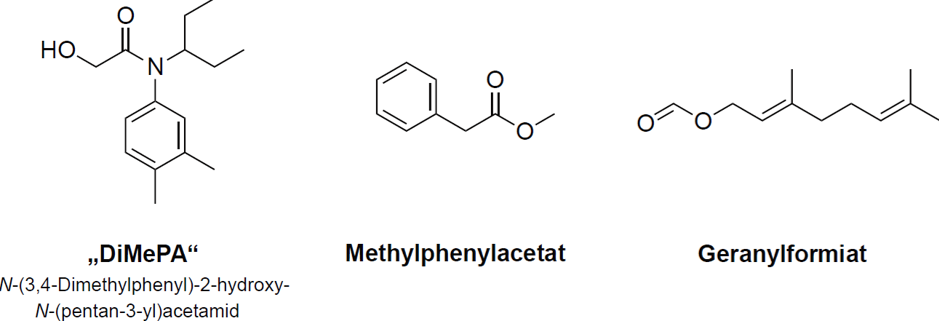
Combination 1
- 2-Methyl-3-buten-2-ol (MB)
- DiMePA (N-(3,4-dimethylfenyl)-2-hydroxy-N-(pentan-3-yl)acetamid)
Combination 2
- 2-Methyl-3-buten-2-ol (MB)
- cis-Verbenol
- Methyl phenylacetate
Combination 3
- 2-Methyl-3-buten-2-ol (MB)
- cis-Verbenol
- Geranyl formate
Testing Phase Begins
The next stage of the project will focus on evaluating these candidate compounds through a series of olfactometer assays. Under controlled laboratory conditions, researchers will investigate how bark beetles respond to specific odor combinations, enabling a detailed assessment of their attractiveness.
The laboratory experiments will provide critical data for selecting the most promising candidates for subsequent field validation. Compounds demonstrating strong behavioral responses will advance to field trials conducted under real forest conditions, where their performance will be compared directly with existing monitoring systems.
Towards More Sustainable Forest Protection
Reaching this milestone marks an important step toward the development of new, knowledge-based solutions for bark beetle monitoring. By exploring alternative attractants, the project seeks to enhance current monitoring capabilities and contribute to more sustainable forest protection strategies.
The first laboratory results are expected in the coming months and will guide the further development and validation of these novel compounds.


