
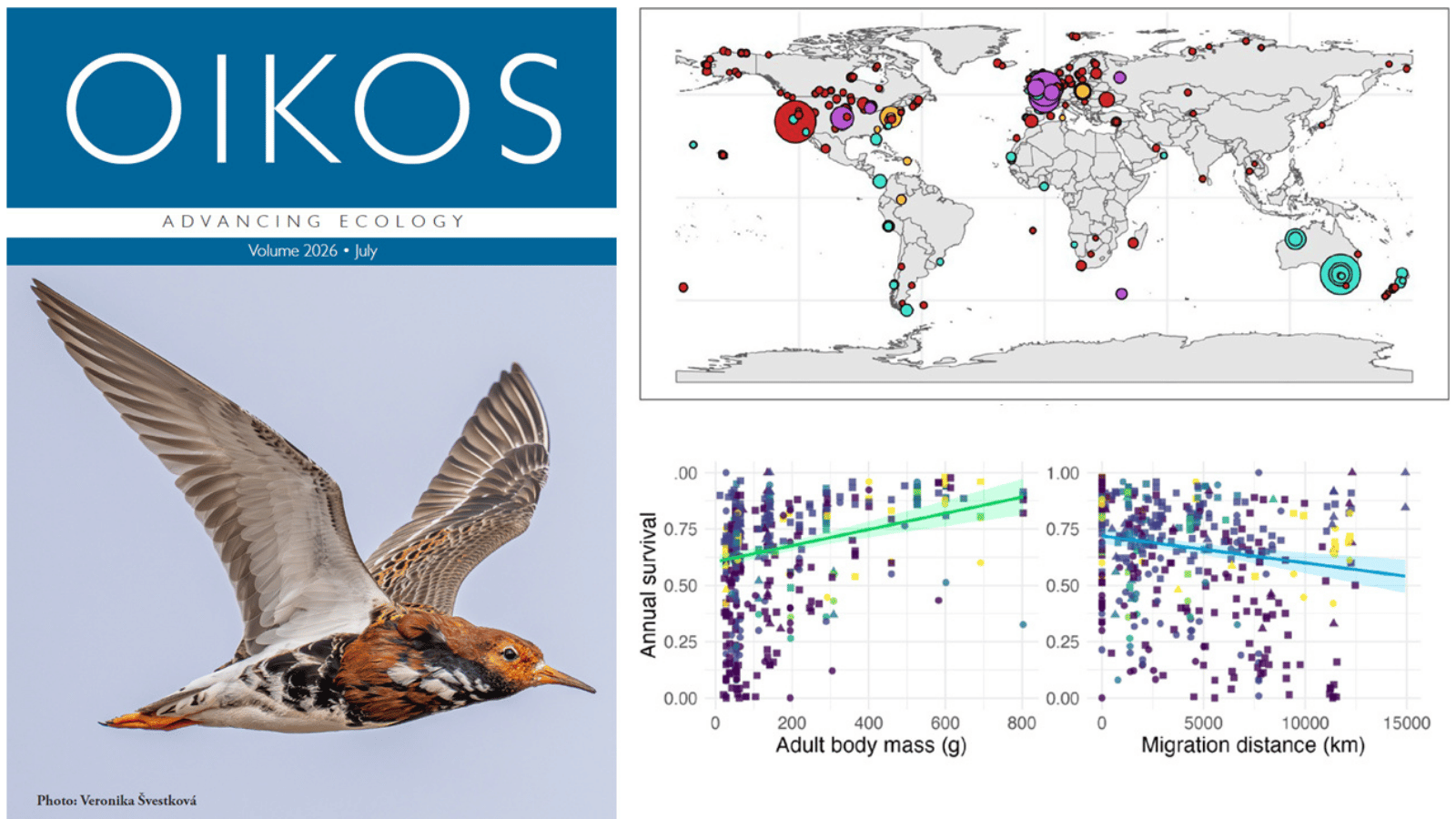


A group of researchers, led and supervised by scientists from the Department of Zoology and Centre for Polar Ecology, Faculty of Science at the University of South Bohemia, have compiled and investigated an extensive dataset on the survival of migratory birds. The recently published study in Oikos, which was selected for the journal cover, highlighted that migrating birds suffered higher mortality, and global mortality significantly increased during the last four decades.
Their study focused on shorebirds, a widespread group of birds, among which some populations exhibit the record of migration distance without stopping. If iconic species of shorebirds are commonly encountered close to the shore, several species breed or stay in proximity to continental lakes or water bodies, like the Northern Lapwing, the Common Redshank or the Common Snipe, which can be encountered around the University for most of the year. Previous studies already highlighted the general threats that shorebirds are globally facing, including an increasing risk of their nests being depredated and declining population trends. However, it was previously unknown if adult birds have also experienced higher mortality recently.
The researchers involved in this study collected annual survival estimates, which correspond to the proportion of individuals surviving from one year to another, from scientific and grey literature. The dataset included nearly 800 records of survival probabilities, which encompassed over 400 populations of more than 100 different shorebird species. They further analysed the survival of birds since 1980 to highlight potential temporal trends affecting survival.
The comparative study highlighted that survival was higher in adults compared to juveniles and was also higher in heavier species. These two patterns were consistent with findings in other bird groups. However, the study also showed a negative impact of migration distance, indicating that populations which travel a further distance between their breeding and their wintering sites also suffer a higher mortality rate.
Finally, this study demonstrated that the global survival probability decreased consistently since 1980. It appears that shorebirds are negatively impacted by the ongoing environmental changes around the globe. Although the exact causes of mortality at the global scale remain unassessed, local studies showed that habitat change, for instance along the migration routes, could be responsible for this increased mortality.
The published study acts as another piece of evidence that some groups of organisms are endangered by ongoing environmental changes, leading to biodiversity loss. Hopefully, it will also stimulate further studies to investigate the different mortality causes and design appropriate conservation measures.
Dillenseger G., Sparkes C. H. J., Székely T., Sandercock B. K., Freckleton R. P. & Kubelka V. 2026: Global analysis of annual survival among shorebirds reveals a negative effect of migration distance and a decline in recent decades. Oikos e11931 (1–17).
Article available on: https://nsojournals.onlinelibrary.wiley.com/doi/full/10.1002/oik.11931.


