Přejít na hlavní obsah

Přírodovědecká fakulta JU

Faculty Sustainability Working Group Meeting – April 2025

  • Seznam štítků: PŘF


We warmly invite all faculty members, staff, and students interested in sustainability to join our April meeting.


Date: Tuesday, April 29, 2025

Time: 3 p.m.

Location: Room C1, Faculty of Science, University of South Bohemia


Dean František Vácha is expected to attend, providing an opportunity to discuss plans related to our faculty's exterior and other sustainability initiatives.

Come and contribute to shaping a more sustainable future for our faculty!

We look forward to seeing you there.


Pavla Fojtíková Coordinator, Faculty Sustainability Working Group 


Jednobuněčná laboratoř: proteinová krystalizace uvnitř buněk

  • Seznam štítků: Publikace
  • Galerie:
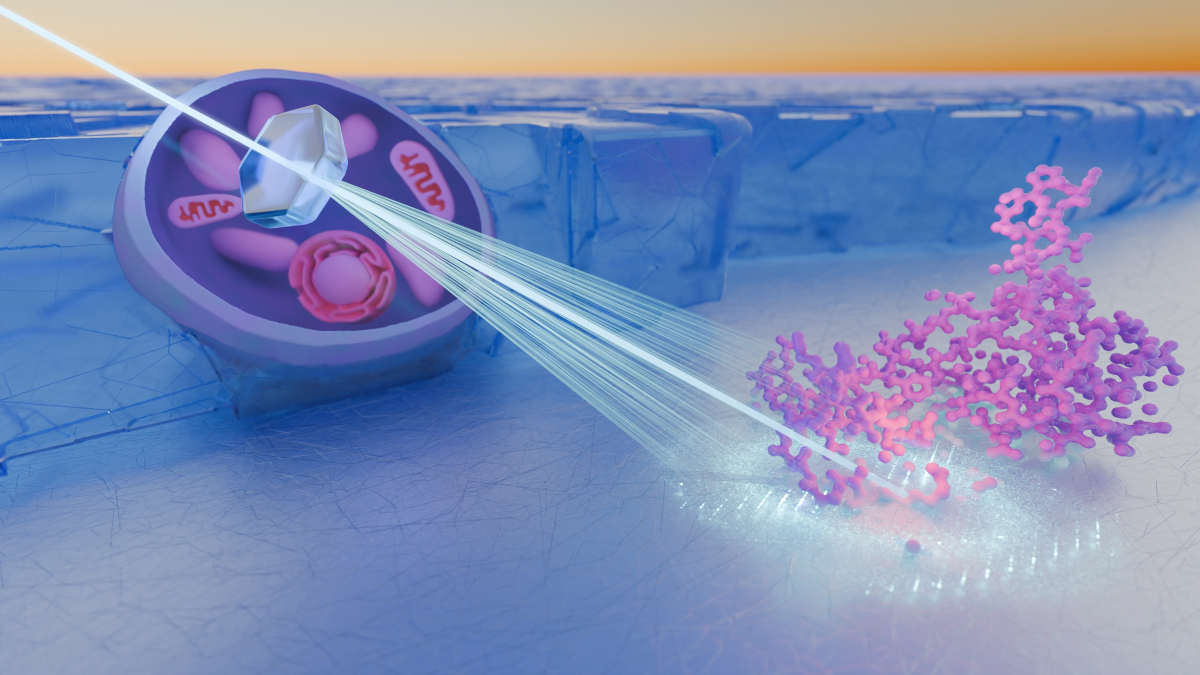
    • Galerie: , Text k fotce: Grafické znázornění elektronové krystalografie: V buňce je nejprve vytvořen krystal studovaného proteinu. Následně je buňka zamražena a obroušena až na úroveň krystalu, z něhož je pomocí elektronové difrakce určena jeho detailní struktura.

Strukturní biologie na úrovni jedné buňky pomocí intracelulární elektronové krystalografie

Vědecký tým z Katedry chemie Přírodovědecké fakulty Jihočeské univerzity, ve složení Š. Bílá, T. Bílý, Z. Franta, R. Tůma, dosáhl průlomového úspěchu v oblasti strukturní biologie. Podařilo se mu určit strukturu proteinu ve vysokém rozlišení z jediného krystalu vyrostlého přímo uvnitř živé buňky. Tento mimořádný výsledek byl umožněn díky úzké spolupráci s Ústavem molekulární genetiky AV ČR (Praha), ELI Beamlines (Praha), Biologickým centrem AV ČR (České Budějovice), Univerzitou v Lübecku (Německo) a Univerzitou v Uppsale (Švédsko).

Nově vyvinutá metoda IncelluloEDkombinuje intracelulární krystalizaci proteinů s in situ trojrozměrnou elektronovou difrakcí pomocí standardního vybavení kryoelektronové mikroskopie (cryo EM). Otevírá cestu k analýze struktur ve vysokém rozlišení přímo v buňkách a umožňuje obejít pracné čištění proteinů a in vitro krystalizaci.

Intracelulární krystalizace se objevila jako slibná strategie ve strukturální biologii, avšak dosavadní přístupy narážely na zásadní omezení. V roce 2024 představil odborný tým Univerzity v Lübecku experimentální protokol InCellCrysturčený ke studiu intracelulárních krystalů pomocí sériové rentgenové krystalografie. Sériová krystalografie však vyžaduje ozáření desítek tisíc buněk obsahujících krystaly, což znemožňuje studium proteinů, které krystalizují pouze v několika málo buňkách. IncelluloED tuto bariéru překonává tím, že umožňuje určit strukturu z jediného krystalu v jediné buňce.

Výkonnost metody IncelluloED byla demonstrována na mikrokrystalu proteinu HEX 1 z houby způsobující rýžovou sněť (Magnaporthe grisea), který byl vypěstován v hmyzí buňce. Zatímco IncelluloED poskytl strukturu s rozlišením 1,9 Å z krystalu o objemu 1,6 µm³, sériová rentgenová krystalografie vyžadovala desetitisíce krystalů s celkovým objemem přes 11 milionů µm³ k dosažení podobného atomárního rozlišení. IncelluloED tak předvedl milionkrát větší úsporu potřebného materiálu pro určení struktury ve vysokém rozlišení.

Kromě své okamžité výkonnosti otevírá IncelluloED nové možnosti pro systematické studium intracelulární krystalizace, například frekvence krystalizace či kvality difrakce, a umožňuje hledat uspořádané nanodomény uvnitř větších, špatně difraktujících krystalů. Budoucí vylepšení, jako je krystalizace v přítomnosti ligandů přirozeně se vyskytujících v buňkách, mohou posílit možnosti vývoje léčiv na základě struktur.

Navzdory své celkové složitosti se vyvinutá metoda ukázala jako robustní: všechny buňky vybrané k analýze obsahovaly difraktující krystaly a žádný vzorek nebyl ztracen. Tím, že vyžaduje pouze jediný krystal uvnitř jediné buňky a využívá standardní platformy cryo EM, přináší IncelluloED strukturní biologii ve vysokém rozlišení do běžného laboratorního prostředí a představuje významný krok v novém směřování oboru — realizaci strukturní biologie na úrovni jedné buňky.

Štěpánka Bílá, Dominik Pinkas, Krishna Khakurel, Juliane Boger, Tomáš Bílý, Janos Hajdu, Zdeněk Franta, Iñaki de Diego Martinez, Roman Tuma, Lars Redecke and Vitaly Polovinkin: Single-Cell Structural Biology with Intracellular Electron Crystallography, Nat Commun (2026). https://doi.org/10.1038/s41467-026-69205-6


14th Visegrad Symposium on Biomolecular Interactions

From May 27 to 30, 2026, the 14th edition of the conference focused on biomolecular interactions (Visegrad Symposium on Biomolecular Interactions) will take place. It is co-organized by a member of our department, Ing. Babak Minofar, Ph.D. This international conference is a traditional platform for sharing the latest knowledge in the field of biomolecular systems and brings together experts from across Europe and beyond. The Visegrad Symposium has been held annually since 2011 and in previous years took place, for example, in Nové Hrady, Gyöngyöstarján in Hungary, and Smolenice in Slovakia. This year, the conference will be held in the Polish town of Spała in the Łódź Voivodeship.

The program will cover a wide range of topics, including:

  • Simulation of biomolecular interactions
  • Measurement of biomolecular interactions
  • Drug development and diagnostics
  • Machine learning and big data

Registration is now open! More information about the program and registration can be found here.

66th Meeting of the Czech Phycological Society

  • Seznam štítků: PŘF

From September 10 to 12, the 66th conference of the Czech Phycological Society will take place in Building B of our faculty. About 70 participants from the Czech Republic and abroad will spend two days discussing cyanobacteria and algae from all possible aspects, from taxonomy and adaptation to extreme conditions to dangerous algal blooms. The conference is being organized on behalf of the faculty by the algology group of the Department of Botany in cooperation with the Biological Center in České Budějovice and the Botanical Institute in Třeboň.

The program and details are available here: 66th Meeting of the Czech Phycological Society

A New Approach to Studying the Origins of Solar and Stellar Flares Using Observations and Numerical Simulations – Sub-THz Band

The Sun represents a unique laboratory for studying a wide range of physical processes occurring in its atmosphere. Although modern space-based and ground-based telescopes offer exceptional observational capabilities, questions regarding the origin, release, and transport of energy in the solar atmosphere—especially during solar flares—remain open. These phenomena can significantly influence so-called space weather and affect the near-Earth environment, including its magnetosphere and biosphere. This growing impact has led to increased interest in a deeper understanding of how the Sun operates.

One of the most intensively studied yet still not fully understood processes is the release of energy during solar flares, the acceleration of charged particles, and the heating of the solar corona. As part of the international bilateral project “Sub-THz Band: A New Approach to Studying the Origins of Solar and Stellar Flares Using Observations and Numerical Simulations”, which was evaluated as “excellent” by the GAČR Presidium upon its completion, we studied these phenomena using a combination of advanced numerical magnetohydrodynamic (MHD) simulations, kinetic models, and radiation transfer simulations. These calculations were compared with observations in the sub-terahertz (sub-THz) band—a spectral region emerging as a new opportunity for exploring solar and stellar flares.

The sub-THz band represents a new “window” into the study of the aforementioned phenomena. In this relatively unexplored part of the electromagnetic spectrum, there is potential for groundbreaking discoveries related to high-energy processes—such as the acceleration of electrons to relativistic speeds or the formation of dense plasma structures during flares. Using modern numerical codes, we conducted a detailed comparative analysis of sub-THz emissions generated during the heating of flare plasma (including the corona, chromosphere, and transition region) by accelerated electrons. This enabled not only a new perspective on the origin of these emissions but also a deeper understanding of the energy release mechanism itself during solar flares.

A. K. Srivastava, S. K. Mishra, P. Jelínek; The Astrophysical Journal, 920, 18, 2021, DOI: 10.3847/1538-4357/ac1519

Smirnova, Victoria; Tsap, Yuriy; Jelínek, Petr; Karlický, Marian, Advances in Space Research, Volume 70, Issue 10, p. 3257-3262. DOI: 10.1016/j.asr.2022.08.064  

Jelínek, Petr; Belov, Sofya; Karlický, Marian, The Astrophysical Journal, Volume 941, Issue 2, id.124, 8 pp. DOI:10.3847/1538-4357/aca40d

S. K. Mishra, K. Sangal, P. Kayshap, P. Jelínek, A. K. Srivastava, S. P. Rajaguru: The Astrophysical Journal 945, 2, 2023. DOI 10.3847/1538-4357/acb058


Contact: doc. RNDr. Petr Jelínek, Ph.D. (Tato e-mailová adresa je chráněna před spamboty. Pro její zobrazení musíte mít povolen Javascript.)

A New Book on Sandstone Landscapes Holding More Memories Than Meets the Eye

A new book with a significant contributions from Petr Pokorný and Michaela Ptáková from the Laboratory of Archaeobotany and Paleoecology at the Faculty of Science, Hinterland. Archeology of the North Bohemian Sandstone Landscapes has now been published by the Prague-based publishing house Kodudek. The title, appealing format, and interesting content introduce both experts and non-expert readers to the exceptionally interesting topic of prehistoric, medieval, and contemporary settlements in the lesser-known landscapes of the northern edges of our country.

Today's archaeology is an integral science of everything acient that has been swept away by time and escaped the memory of living people and written sources. A necessary consequence of its development is the immense diversity and a complexity of research methods. The most modern methods of chemistry, physics, geology, and biology are often used. The team of authors, which has been intensively studying sandstone landscapes for about a quarter of a century, is truly interdisciplinary. The sandstones of northern Bohemia have proven to be exceptionally rich in traces of both the distant and recent past. They are characterized by an abundance of various natural archives that bear these traces. Their research gradually revealed a picture of the unique development of sandstone landscapes, which, although they lay on the edge of the main settlement enclaves for millennia, were at the same time their essential, "nourishing" hinterland.

For most of the time under review, these landscapes were forested and difficult to traverse. Despite their natural-cultural hybridity, nature always had the upper hand, so to speak. The poor soil and rugged terrain allowed for only limited agricultural activity, if any. But never, or at least most of the time, was it completely wild. People passed through the rock labyrinths, lived there permanently or temporarily, hunted there, gathered forest fruits, obtained wood, and grazed domestic animals. They hid there from adversity and other people. It is a surprisingly colorful and, for our time, perhaps even instructive history.

https://www.kosmas.cz/knihy/559021/hinterland.-archeologie-severoceskych-piskovcovych-krajin/?srsltid=AfmBOoo2ZTZmYDGH1Lo_Uss8xEYlAmCBD2QAkHTFcw37SUXsoQbQG5qy

A student of the Faculty of Science will search for life on Mars

  • Seznam štítků: Tiskové zprávy
  • Galerie:
    • Galerie:
    • Galerie:
    • Galerie:
    • Galerie:
    • Galerie:
    • Galerie:

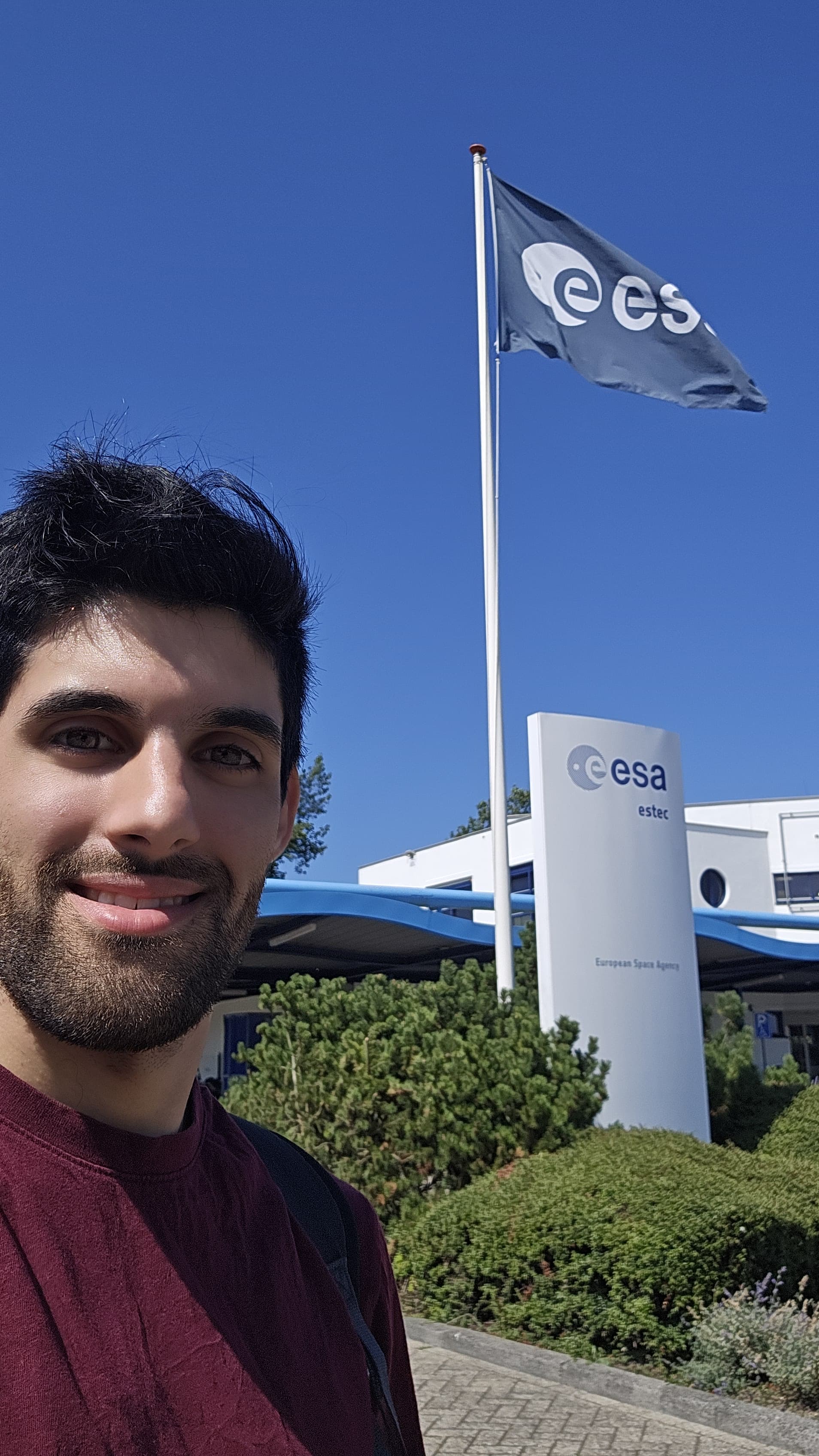
He is a student of the Biological Chemistry program at the Faculty of Science of the University of South Bohemia. As a researcher, he mainly focuses on mapping. He himself says that without participating in the Polar Ecology course at the Czech Arctic Research Station of the University of South Bohemia in Svalbard, he would never have made it into the European Space Agency (ESA) project. Argentinean Lucas Fernandez has already moved to the Netherlands, where he is starting his work on the ExoMars mission these days.

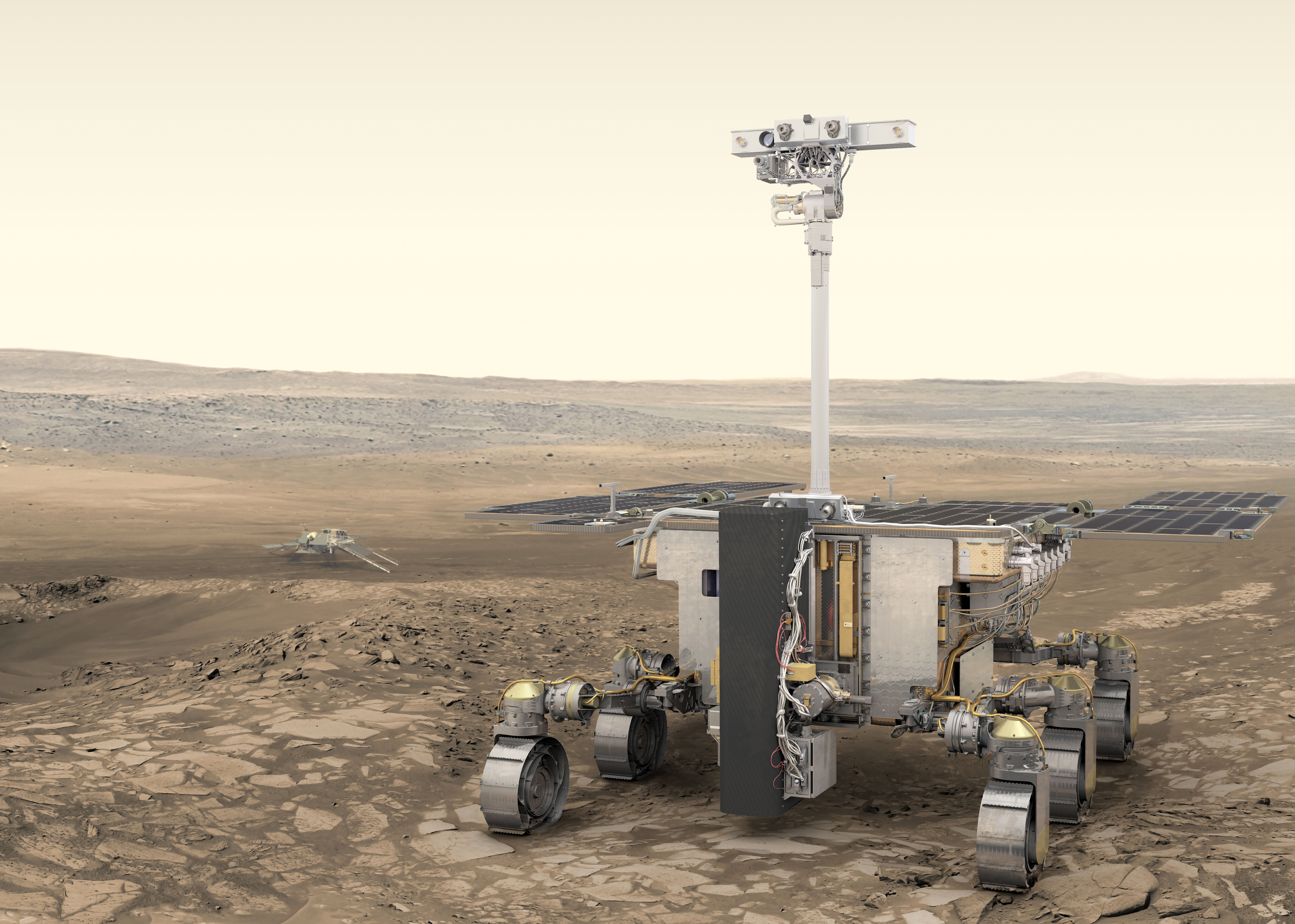
He submitted his application to the space project seven months ago. 383 applicants passed the initial ESA selection criteria. From this pool, Lucas Fernandez was selected for the team of researchers whose task will be to analyze images of the Red Planet sent to Earth by orbiting probes. The highlight of the mission is the launch of a rover named after the famous scientist Rosalind Franklin to Mars in 2028. Its task will be to search for signs of past or present life.

“My task in this mission will be to analyze surface data from Mars sent by probes, together with surface data obtained by NASA’s Curiosity and Perseverance rovers. The goal is to identify the most promising areas for searching for life and to evaluate potential hazards that the Rosalind Franklin rover might encounter,” explains Lucas Fernandez, who, from June 17, 2025, has access to all the necessary systems and data of the European Space Agency at its ESTEC (European Space Research and Technology Centre) headquarters near Amsterdam.

The international team working on the mission is huge. It includes geologists, mineralogists, IT experts, and technical engineers. Lucas Fernandez will be working on mapping the rover’s landing area with two other colleagues. They will also use images to determine what types of rocks and minerals are in the area. The Rosalind Franklin rover will be equipped with a drill capable of reaching up to two meters below the surface. Scientists are almost certain that, due to strong UV radiation, there is no life on the surface of Mars. However, using the rover, they want to investigate if something could survive just one meter below the surface of the Red Planet.

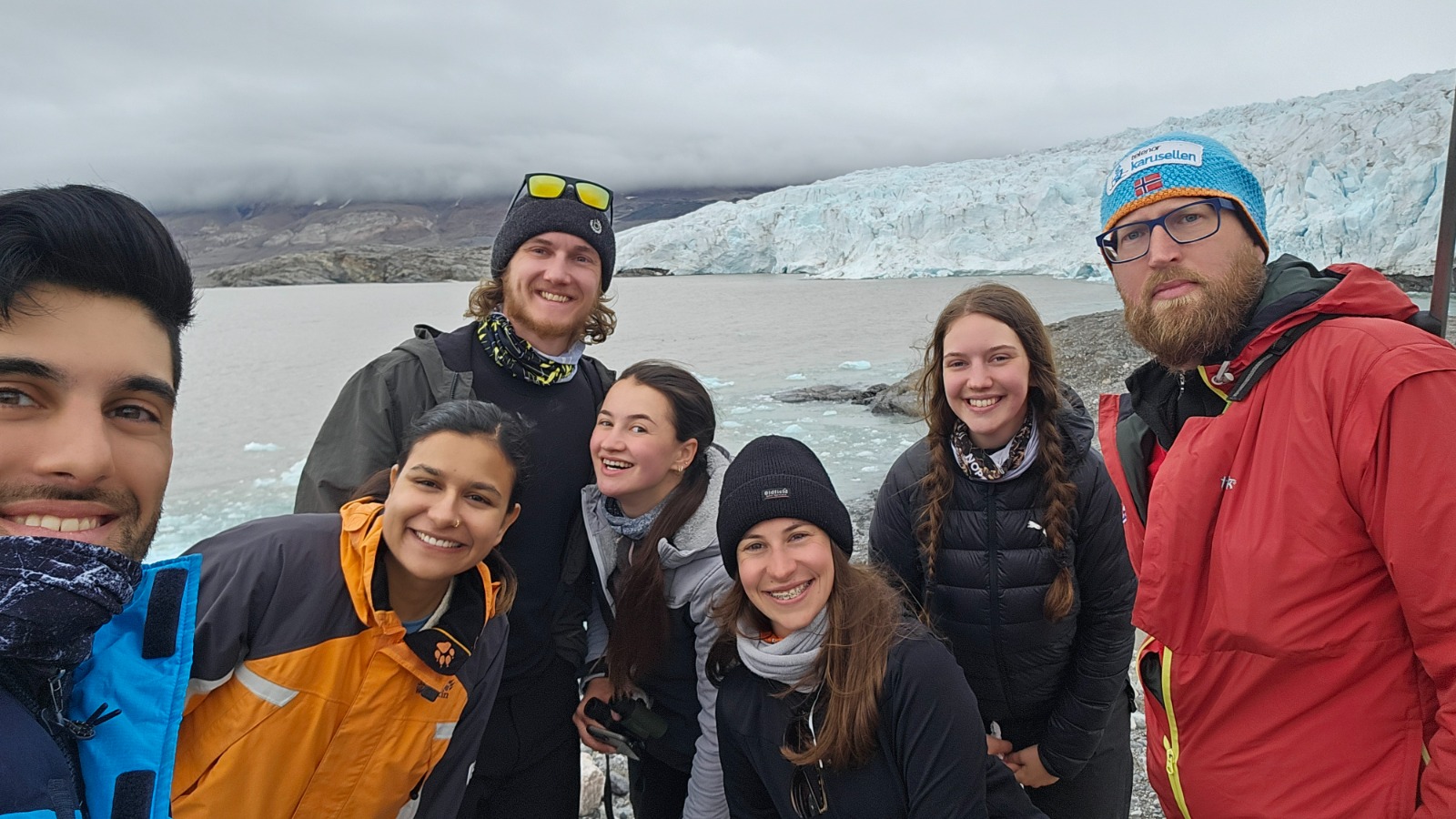
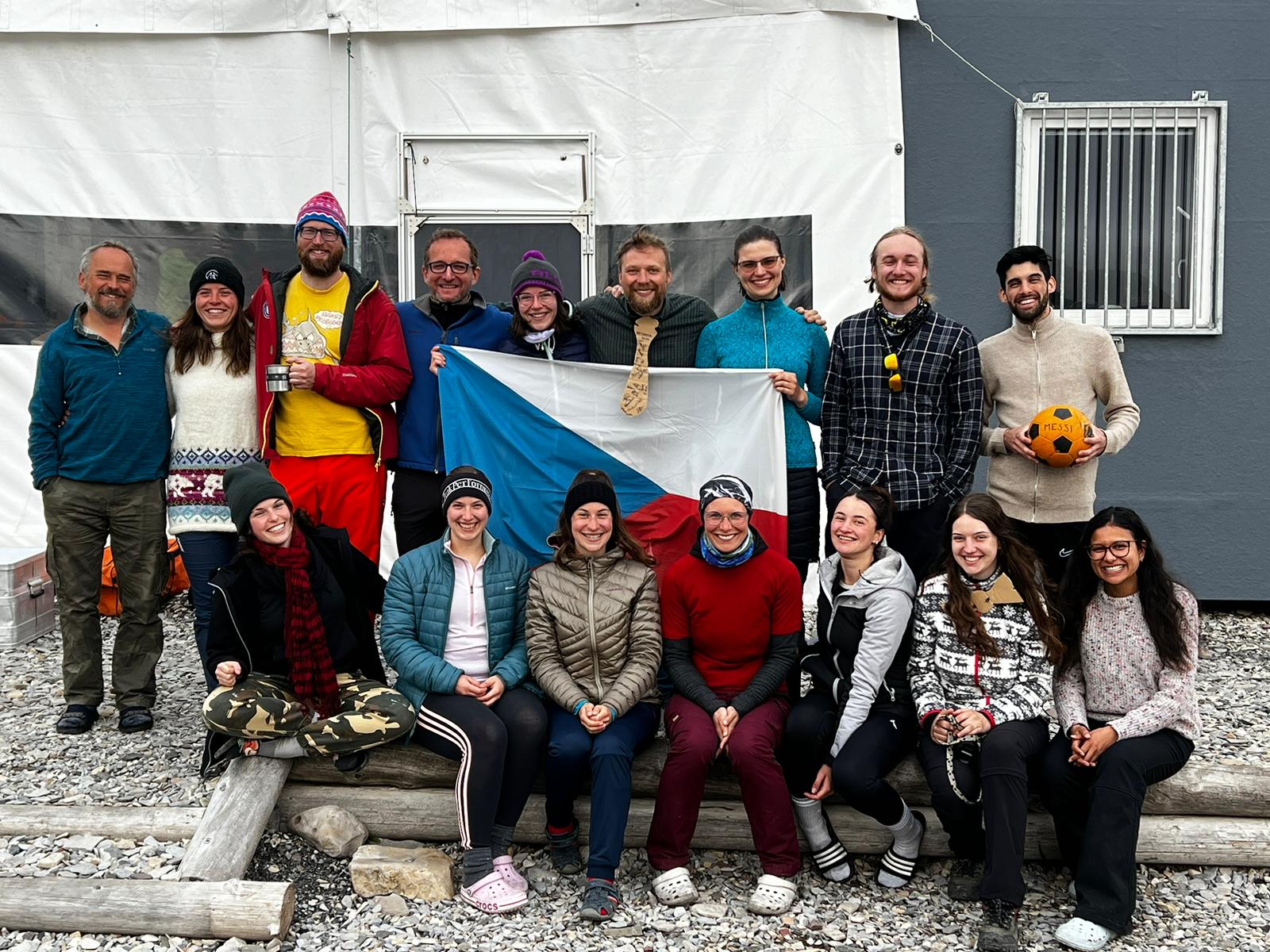
“Our team is basically divided into two groups. One part believes that life once existed on Mars, but not anymore, and the other – to which I belong – thinks that it is still there. This is because we have certain signals, but not enough evidence. We are scientists; we need strong proof. And that is exactly the goal of this mission. Essentially, to find life, whether it’s from the past or still present today,” adds Lucas Fernandez, who openly says that the course he took at the University of South Bohemia’s research station in Svalbard, in the group led by the head of the Centre for Polar Ecology, Jiří Bárta, significantly helped him get into the ESA program. For example, in polar conditions, they collected drill cores for subsequent analysis. This is exactly the kind of work the rover will be doing on Mars.

“Fieldwork in extreme conditions similar to those on Mars, combined with the analysis of satellite images, was exactly what the space agency was looking for. Not all universities have a Centre for Polar Ecology. Having it at the University of South Bohemia is a great privilege and a unique opportunity. There are a number of people here who are at least partially involved in astrobiology as well. And they work in areas that are actually quite similar to Mars,” describes Lucas Fernandez, outlining his path to international success in this prestigious project.

“The Centre for Polar Ecology has been studying organisms living in the extreme conditions of the Arctic for almost 20 years. Thanks to our research station, we have joined the network of international institutions offering this unique opportunity in the Czech Republic. As part of the ‘Polar Ecology’ course, the practical part of which takes place in Svalbard, we educate future experts in botany, zoology, and microbiology. During our polar expedition, I was Lucas’s mentor. His main role in the project was as a ‘data manager’ responsible for the precise collection of data. He designed and implemented an innovative approach, which, in my opinion, is the most significant contribution to his current work at ESA – he created a method for comparing field measurements with data from satellite images to determine the relationship between soil properties and the measurement of albedo - surface reflectivity,” explains Jiří Bárta, head of the Centre for Polar Ecology at the Faculty of Science, University of South Bohemia in České Budějovice.

Work on the Rosalind Franklin rover, which is due to head to Mars in 2028, is being completed by the ESA international team and should be finished this year. The rover will be launched to the Red Planet by a rocket, most likely built by a private investor. A landing module is also under construction.

Bachelor's thesis defences and state final exams in June 2026

Bachelor's thesis defences

11. 6. 2026, C4

08:30 - 09:15: Bioinformatics identification and characterisation of Wolbachia
prevalence in a tropical skipper butterfly taxon (Hesperiidae: Eudaminae) using Whole-Genome Sequencing data.

9:15 - 10:00: Characterization of the role of new intellectual disability gene ARGLU1 in
cognitive function with Drosophila.

10:00 - 10:45: Chemical composition of epicuticle in tropical skipper butterflies

10:45 - 11:30: Occurrence of arbuscular mycorrhizal fungal structures in fine
roots of Holcus lanatus from selected wet grassland sites.

11:30 - 12:15: Diversity and Abundance of Cyanobacteria and Microalgae in long term
manipulatede soil crust ecosystem in front of glacier, Svalbard, the Arctic.

13:15 - 14:00: The Role of Sugar in the Nutrition of Ladybugs.

14:00 - 14:45: De novo DNA methylation establishment in oocytes of African mole-rats.

14:45 - 15:30: Water Stable Isotope Signals in Molecules Secreted by Algae.

12. 6. 2026, B8

08:30 - 09:15: Purification, functional characterization, and lipid interaction of a cold
stress protein found in Chymomyza costata.

9:15 - 10:00: loCaM7 as a Novel Prenylation-Capable Calmodulin in Arabidopsis
thaliana.

10:00 - 10:45: Transformation of marine protist Paradiplonema papillatum -
characterisation of selected unknown proteins.

10:45 - 11:30: Development of spectroscopic assays for analysis of stability of pigmentprotein
complexes.

11:30 - 12:15: Role of G12 protein and beta-arrestins in GPCR signalling.

13:15 - 14:00: Purification of polyclonal antibody against tick-borne encephalitis virus capsid
protein.

14:00 - 14:45: Cloning, expression and purification of the relapsing fever spirochete Borrelia
duttonii antigenic proteins.

14:45 - 15:30: Cloning and Expression of selected Antigenic Proteins from Borrelia duttonii.


State final exmas

17. 6. 2026

  • Biochemistry: C5, 8:00 - 11:30, 12:30 - 17:00
  • Molecular Biology and Genetics: C4, 8:00 - 11:30, 12:30 - 17:00
  • Biology of Microorganisms: C3, 8:00 - 10:30, 12:30 - 13:30
  • Genomics and Proteomics: C3, 15:00 - 16:00
  • Biomedicine: PC2, 12:30 - 15:00
  • Biology of Animals: PC2, 8:00 - 9:00

Blíží se 14. ročník sympozia na téma biomolekulárních interakcí

Ve dnech 27.–30. května 2026 se uskutečníjiž 14. ročník konference zaměřené na téma biomolekulárních interakcí (Visegrad Symposium on Biomolecular Interactions), na jejíž organizaci se podílí také zaměstnanec naší katedry, Ing. Babak Minofar, Ph.D. Tato mezinárodní konference je tradiční platformou pro sdílení nejnovějších poznatků v oblasti biomolekulárních systémů a propojuje odborníky z celé Evropy i dalších částí světa. Visegrádské sympozium se každoročně pořádá již od roku 2011 a v minulých letech se konalo například v Nových Hradech, ve městě Gyöngyöstarján v Maďarsku, či ve slovenské Smolenici. Letos se konference uskuteční v polském městě Spała v Lodžském vojvodství.

Program nabídne široké spektrum témat, mezi nimi:

  • Simulace biomolekulárních interakcí
  • Měření biomolekulárních interakcí
  • Vývoj léčiv a diagnostika
  • Strojové učení a big data

Registrace je již otevřena! Více informací o programu a přihlášení naleznete zde.

Cena pro studentku Katedry chemie

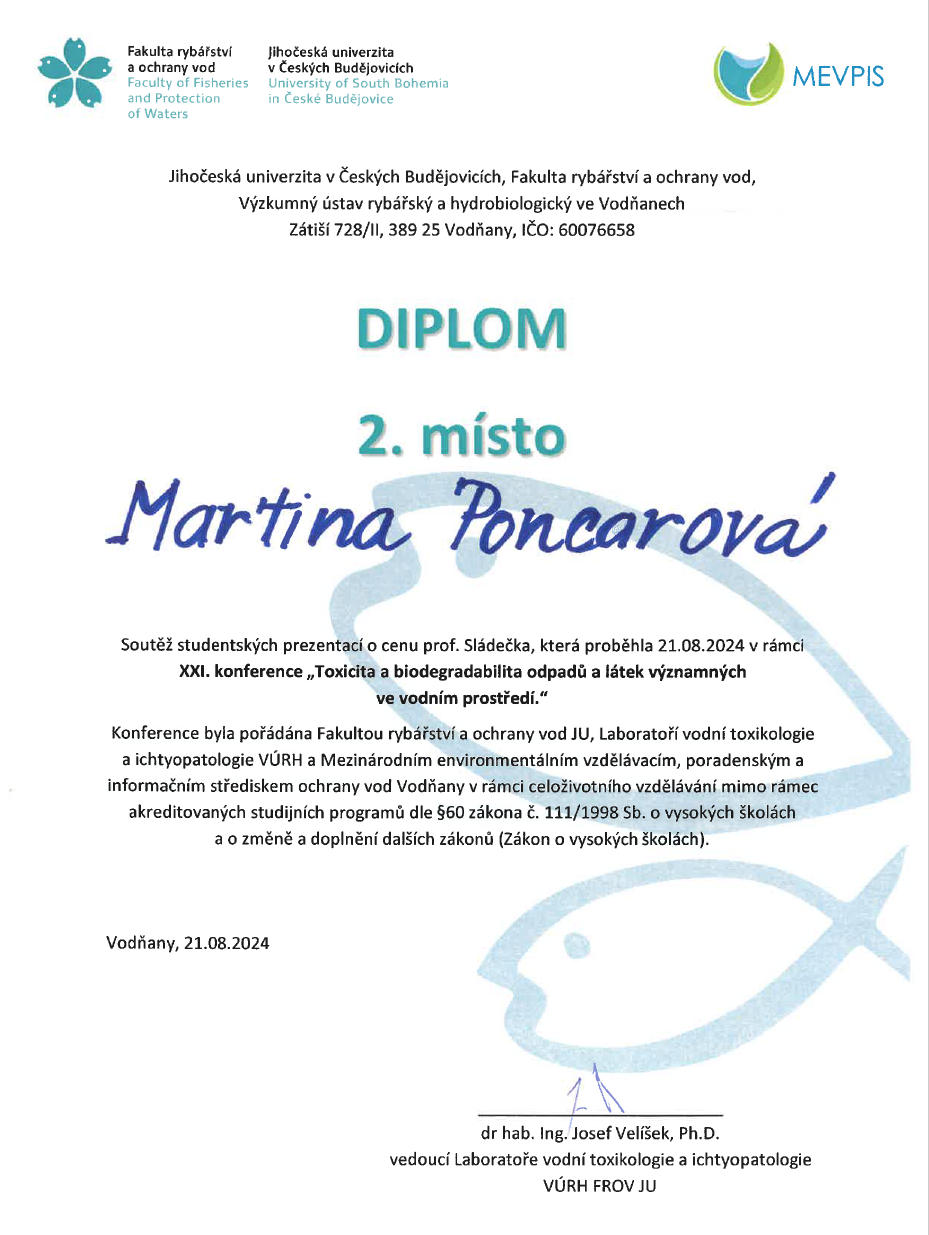
Studentka doktorského studia Katedry chemie Mgr. et Mgr. Martina Poncarová získala 2. místo v soutěži Studentských prezentací o cenu prof. Sládečka, která se konala 21.8.2024 v rámci XXI. konference ,,Toxicita a biodegradabilita odpadů a látek významných ve vodním prostředí. "

Českobudějovičtí vědci hostili výroční konferenci České společnosti pro hmotnostní spektrometrii

  • Seznam štítků: PŘF
  • Galerie:
    • Galerie:
    • Galerie:
    • Galerie: , Text k fotce: Snímek z laboratoře Biologického centra AV ČR, která používá hmotnostní spektometrii a je spoluorganizátorem konference. Foto: Pavlína Jáchimová, AV ČR
    • Galerie:
    • Galerie:
    • Galerie:
    • Galerie:

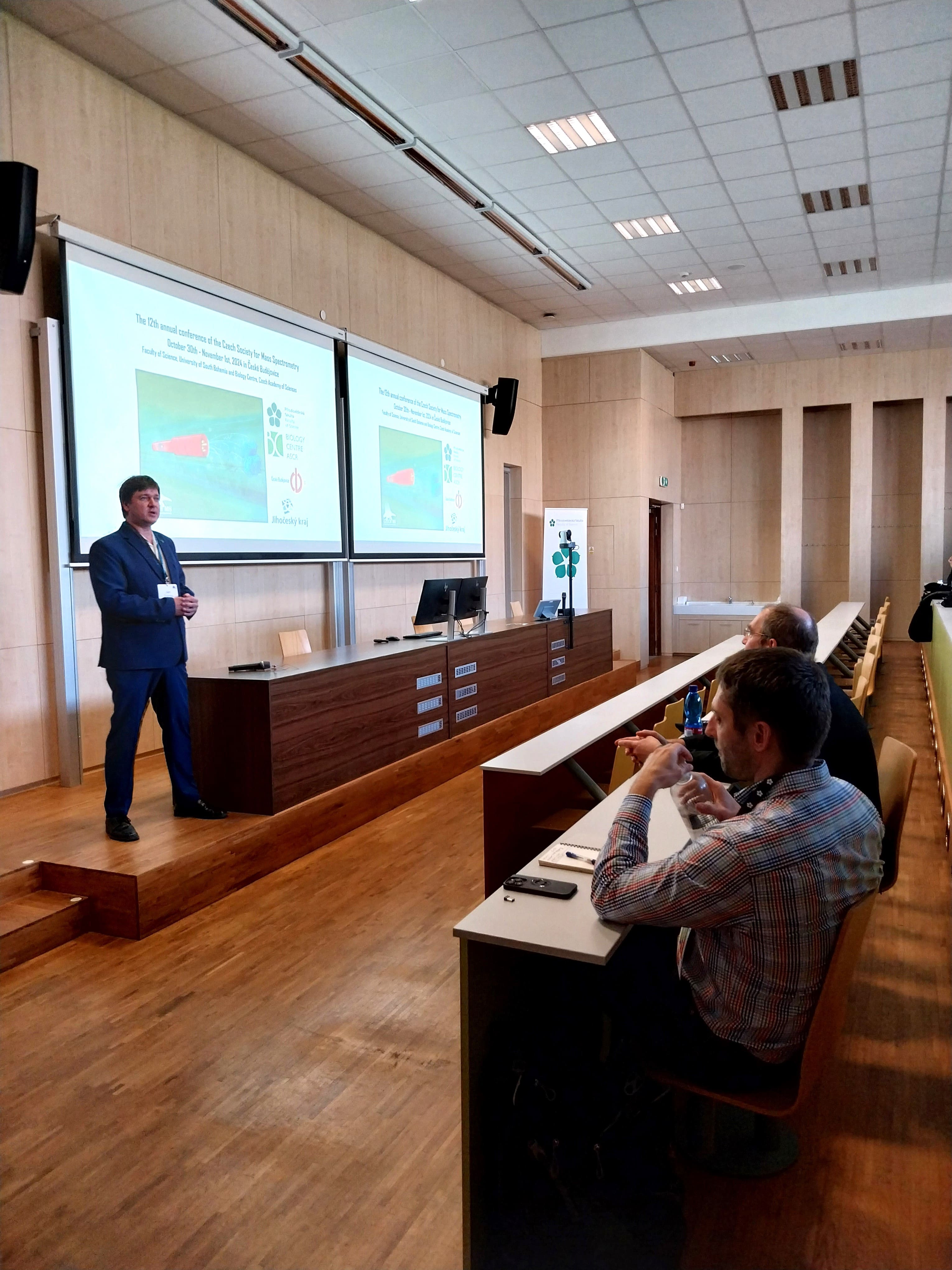
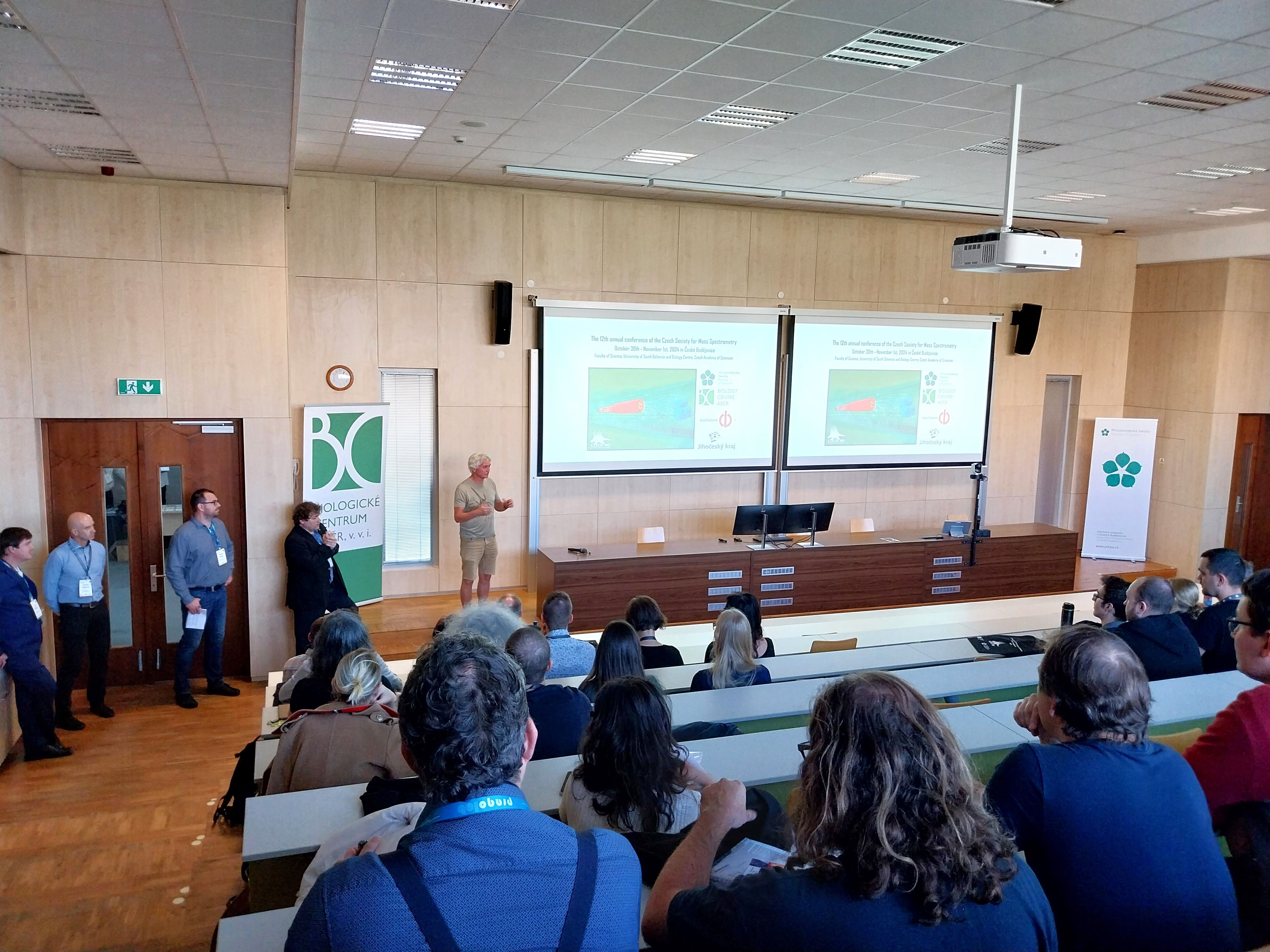
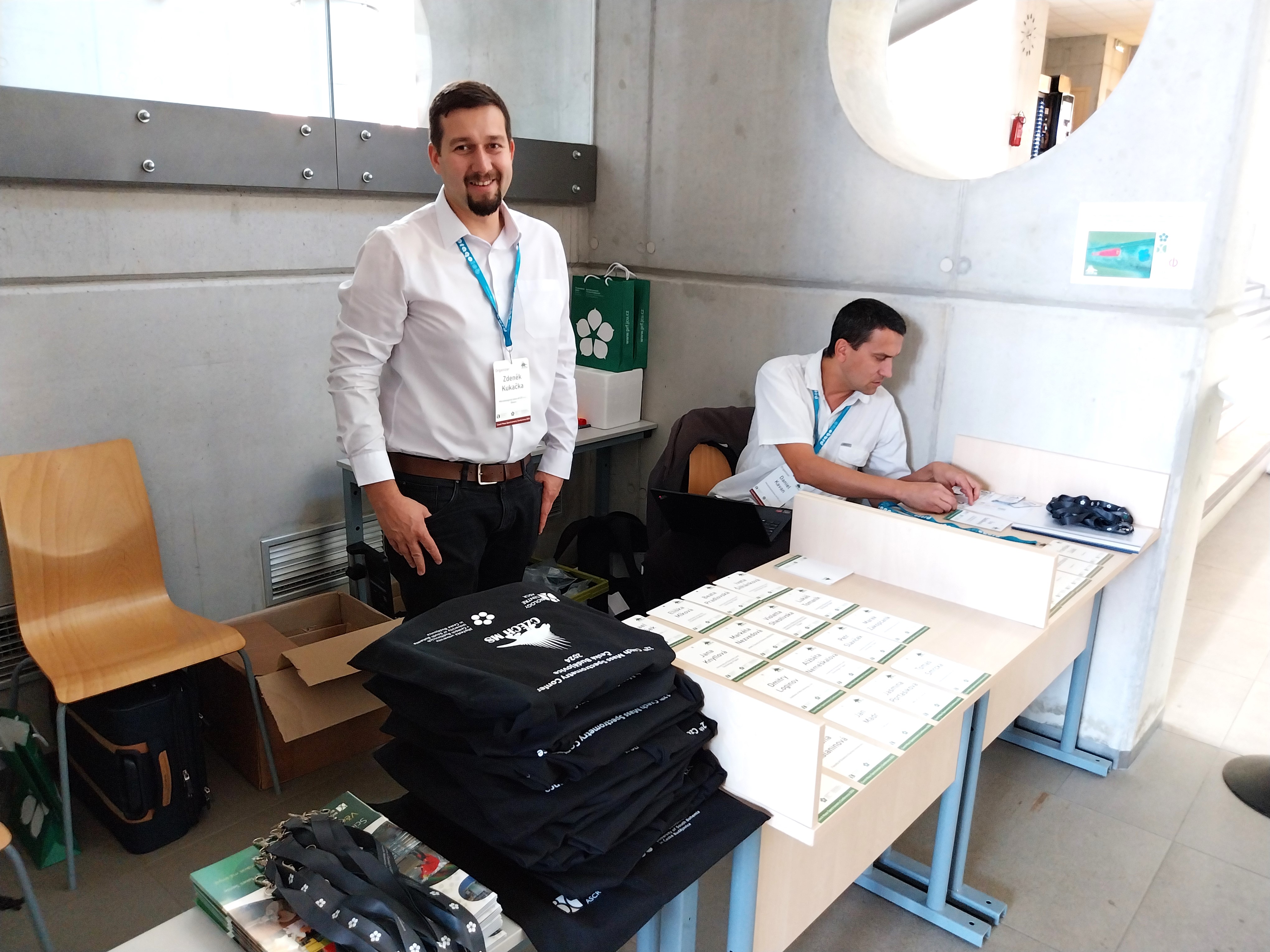
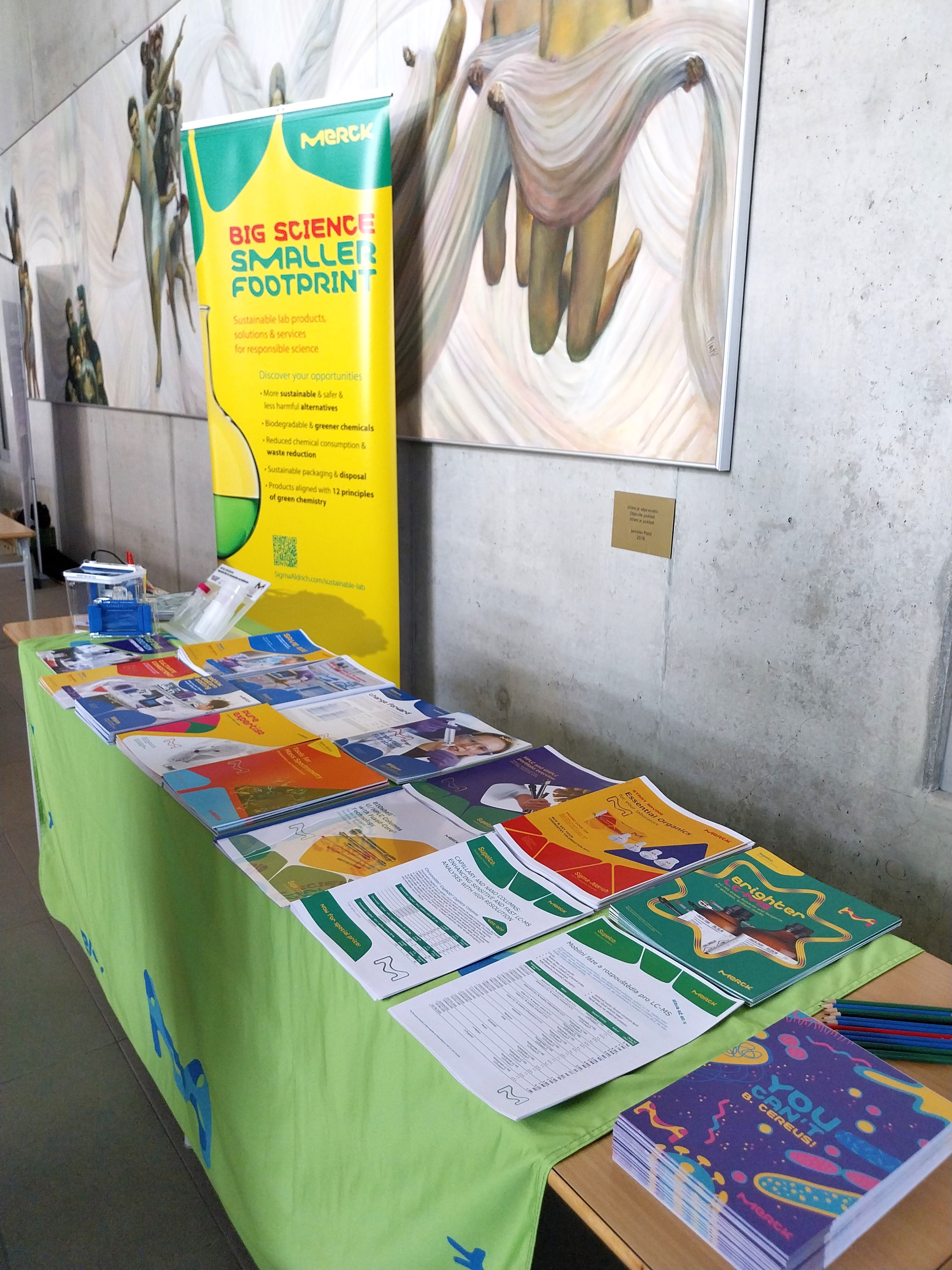
Jihočeská univerzita v Českých Budějovicích a Biologické centrum Akademie věd České republiky hostily na přelomu října a listopadu 12. ročník České konference hmotnostní spektrometrie (CMSC 2024). Konference se zúčastnilo přibližně 100 účastníků z celé České republiky i ze zahraničí, z nichž více než 70 % tvořili studenti a mladí vědci. Tato akce tak představuje jedinečnou příležitost k prezentaci prací jednotlivých výzkumných skupin s následnou výměnou zkušeností a poznatků mezi zkušenými vědci a nadějnými studenty.

Hmotnostní spektrometrie je významná analytická metoda, která se využívá nejen k určování chemické struktury látek, ale i pro vysoce spolehlivé stanovování obsahu těchto látek v nejrůznějších vzorcích všech skupenství i původu. Nachází tak široké uplatnění v biochemii, farmacii, lékařství, toxikologii a v mnoha dalších vědních oborech a má nezastupitelnou roli např. ve výzkumu léčiv, diagnostice nemocí či studiu metabolických drah aj. 

Konference, pořádaná v úzké spolupráci s Austrian Proteomics and Metabolomics Association, zahrnuje významnou spolupráci s vědeckými institucemi z Rakouska a dalších zemí, což zajišťuje mezinárodní charakter této události. Plenární přednášky přednesli prof. Wolfram Weckwerth z Universität Wien a Dr. Robert Mistrík, zakladatel společnosti Bitmoderna, s.r.o., kteří patří mezi špičky v oblasti proteomiky a metabolomiky. Za PřF JU přednesli své příspěvky Dr. Peter Koník, Mgr. Karel Hořejší, Mgr. et. Mgr. Martina Poncarová a Bc. Klára Švihovcová.

Jedním z cílů konference bylo také představit vědecká pracoviště zaměřená na hmotnostní spektrometrii v Jihočeském kraji, čímž se podporuje nejen výzkum v tomto regionu, ale i možnost navazování nových vědeckých spoluprací. Účastníci měli příležitost se seznámit s výzkumnými pracovišti na Jihočeské univerzitě i Biologickém centru AV ČR.

Konference byla pořádána s finanční podporou Jihočeského kraje a byla spolufinancována Statutárním městem České Budějovice.  

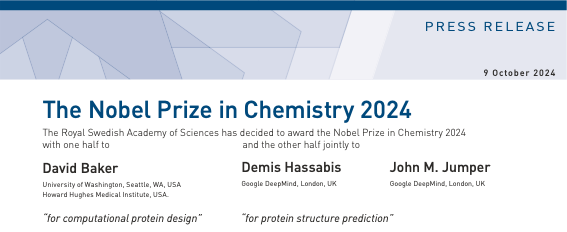
Chemistry Nobel Prizes 2024

Back to Dept. of Chemistry

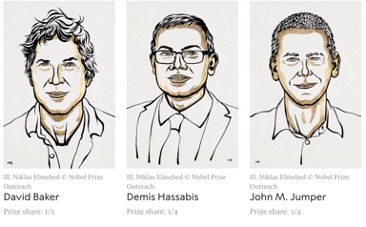
The Nobel Prize in Chemistry 2024 is about proteins, life’s ingenious chemical tools. David Baker has succeeded with the almost impossible feat of building entirely new kinds of proteins. Demis Hassabis and John Jumper have developed an AI model to solve a 50-year-old problem: predicting proteins’ complex structures. These discoveries hold enormous potential.


More info about the Nobel prize.

https://www.nobelprize.org/prizes/chemistry/2024/press-release/

Community ecology in a changing world

A two-day scientific workshop for students featuring international guests from France, the UK, Switzerland, and Croatia. The program includes student presentations of their own research and open discussions on current climate stressors and ecological responses. This will be a unique opportunity to meet, network, and receive feedback. Primarily intended for Master's and Ph.D. students, but other participants are also welcome.


The workshop will take place on October 21–22, 2025.

Registration and abstract submission by September 25, 2025 here: Community Ecology in a Changing World

Invitation available for download in PDF format.

Congratulations to students for their awarded SGA grants

  • Seznam štítků: Our achievements

Back to Dept. of Chemistry

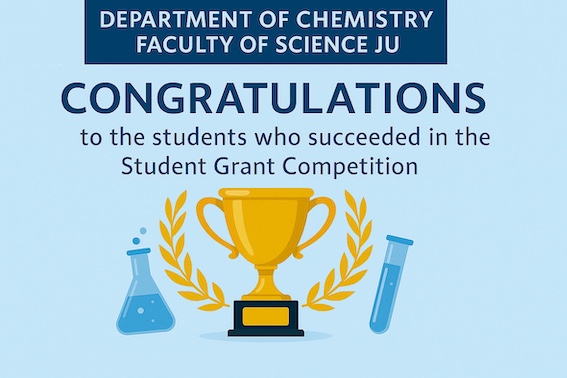
Congratulations to Chemistry students and students supervised by supervisors from our Department for their awarded SGA grants!!!

Gáspár Bondor (BSc Biological Chemistry) / supervisor Tomáš Polívka

Karina Kurz (BSc Biological Chemistry) / supervisor Max Pendlebury

Sidney Robiczek (BSc Biological Chemistry) / supervisor Jarmila Štěrbová

Anna Šišova (BSc Biological Chemistry) / supervisor Karel Hořejší

Aknur Temirbayeva (BSc Biological Chemistry) / supervisor Fadel Fakih

Viktoriia Zhurina (BSc Biological Chemistry) / supervisor Dagmar Bystřická


Eliška Bauerová (MSc Clinical Biology) / supervisor Hana Štrosserová (Mašková)

Matěj Doškář (MSc Clinical Biology) / supervisor Filip Dyčka

Matěj Lácha (MSc Clinical Biology) / supervisor Hana Štrosserová (Mašková)


Czech Society for Mass Spectrometry conference attracted nearly two hundred participants

  • Seznam štítků: FoS
  • Galerie:
    • Galerie:
    • Galerie:
    • Galerie:
    • Galerie:
    • Galerie:
    • Galerie:
    • Galerie:

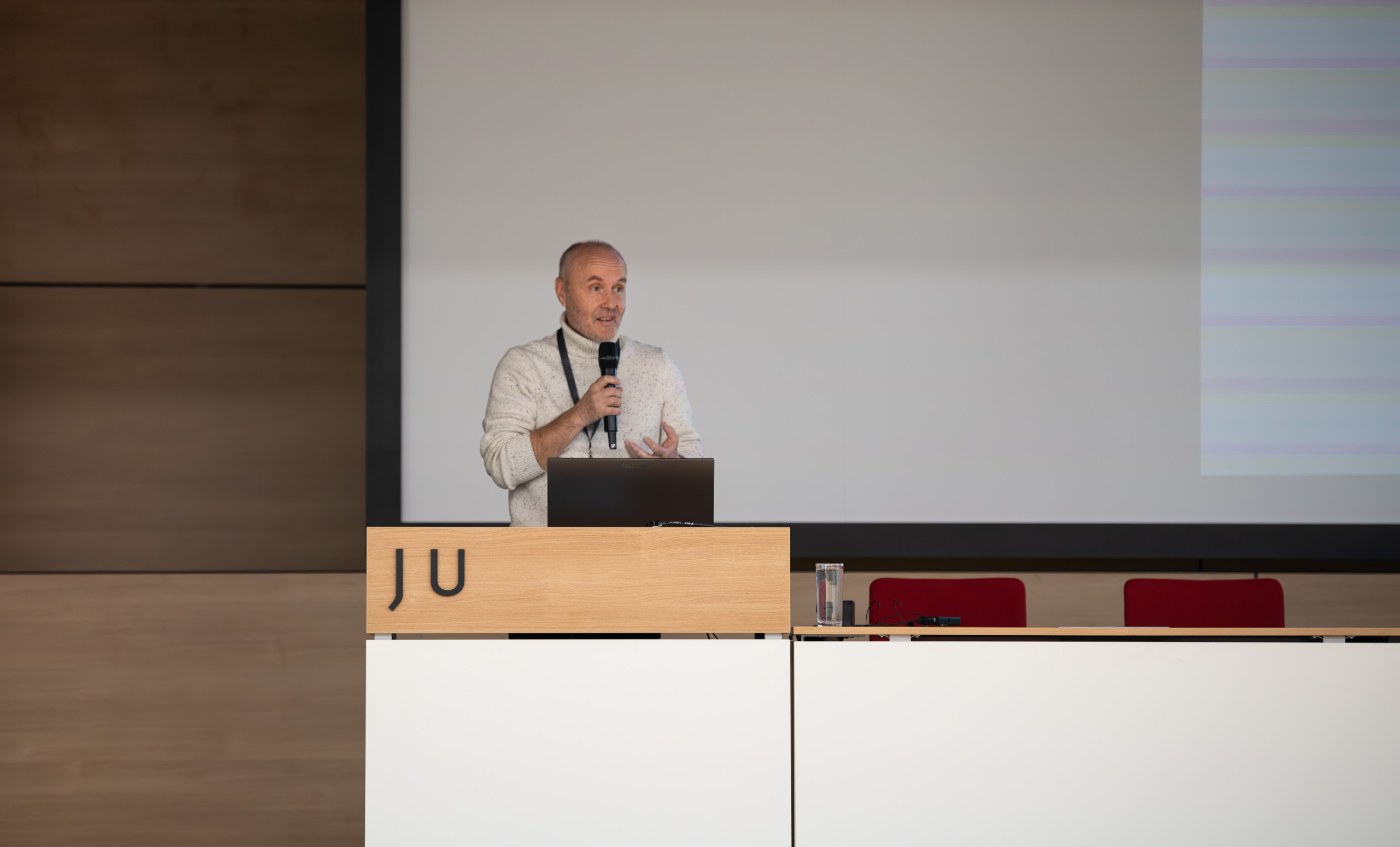
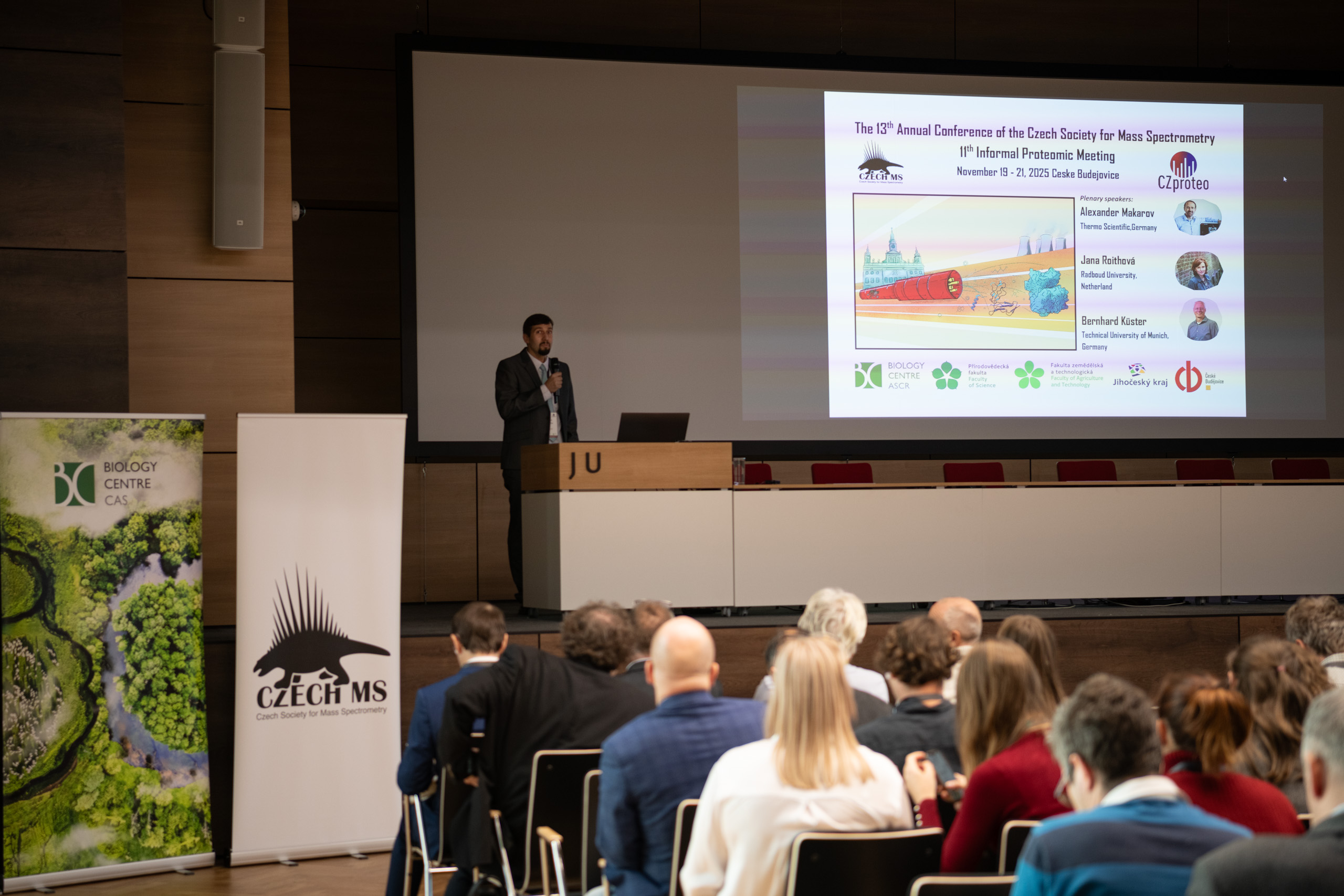
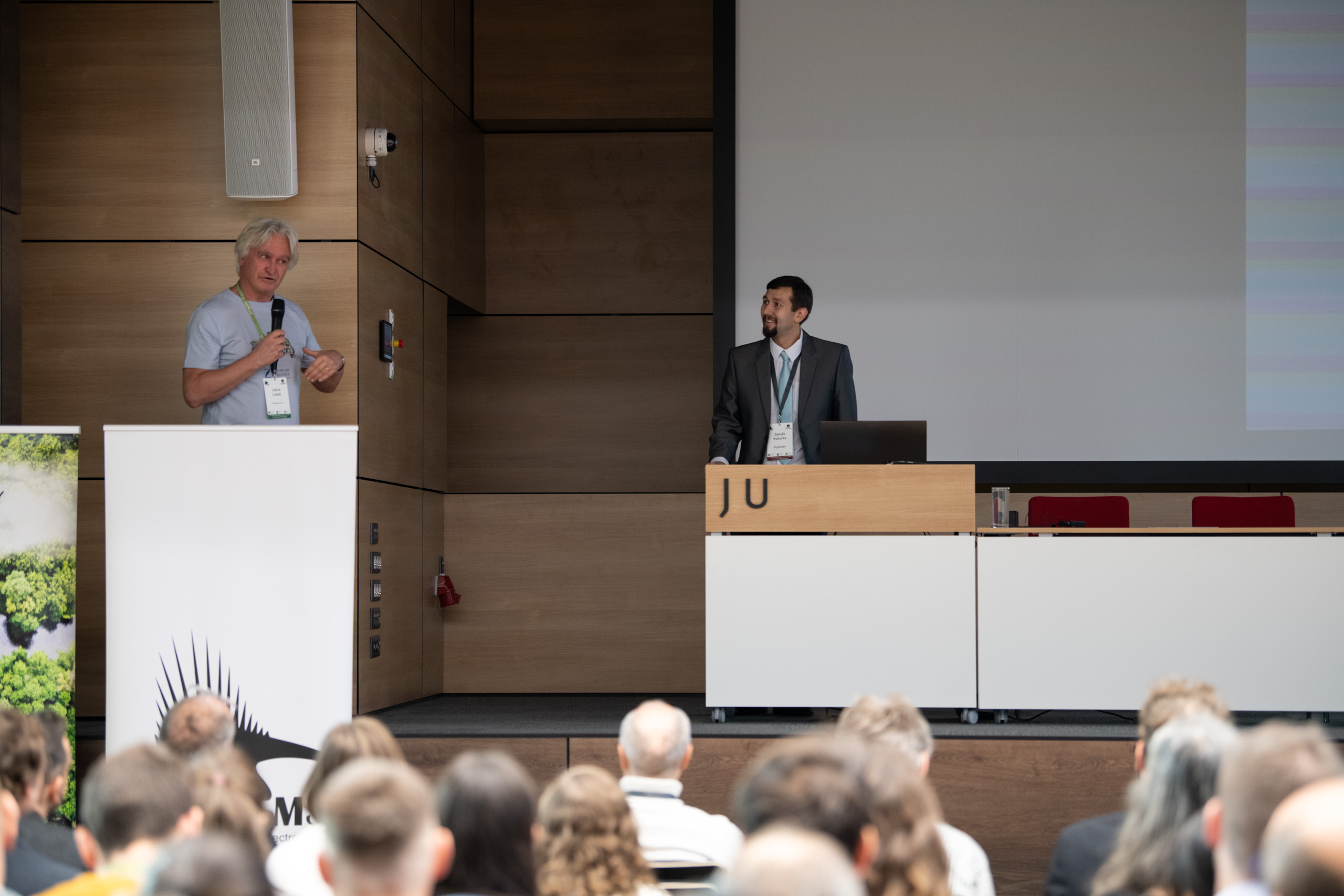
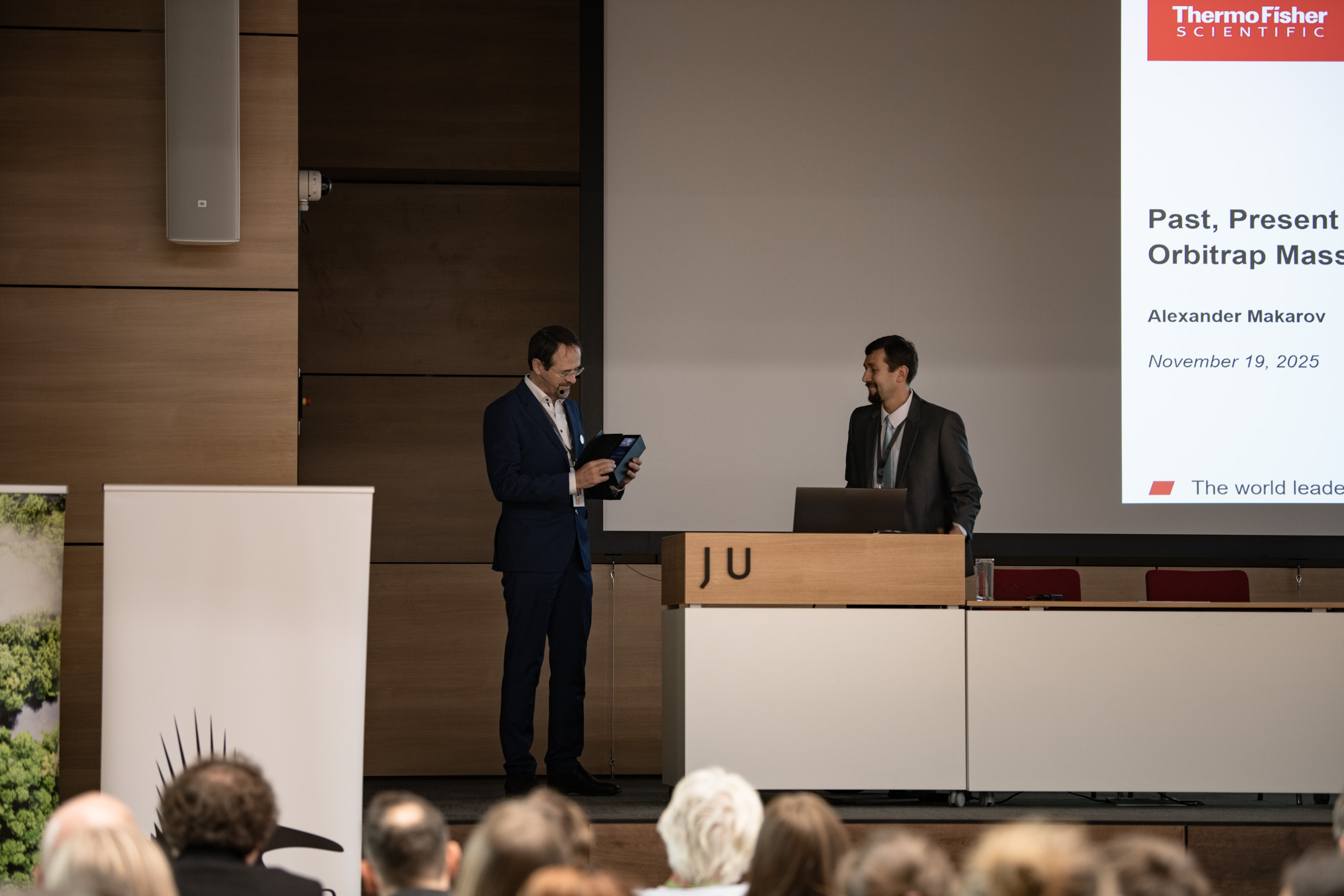
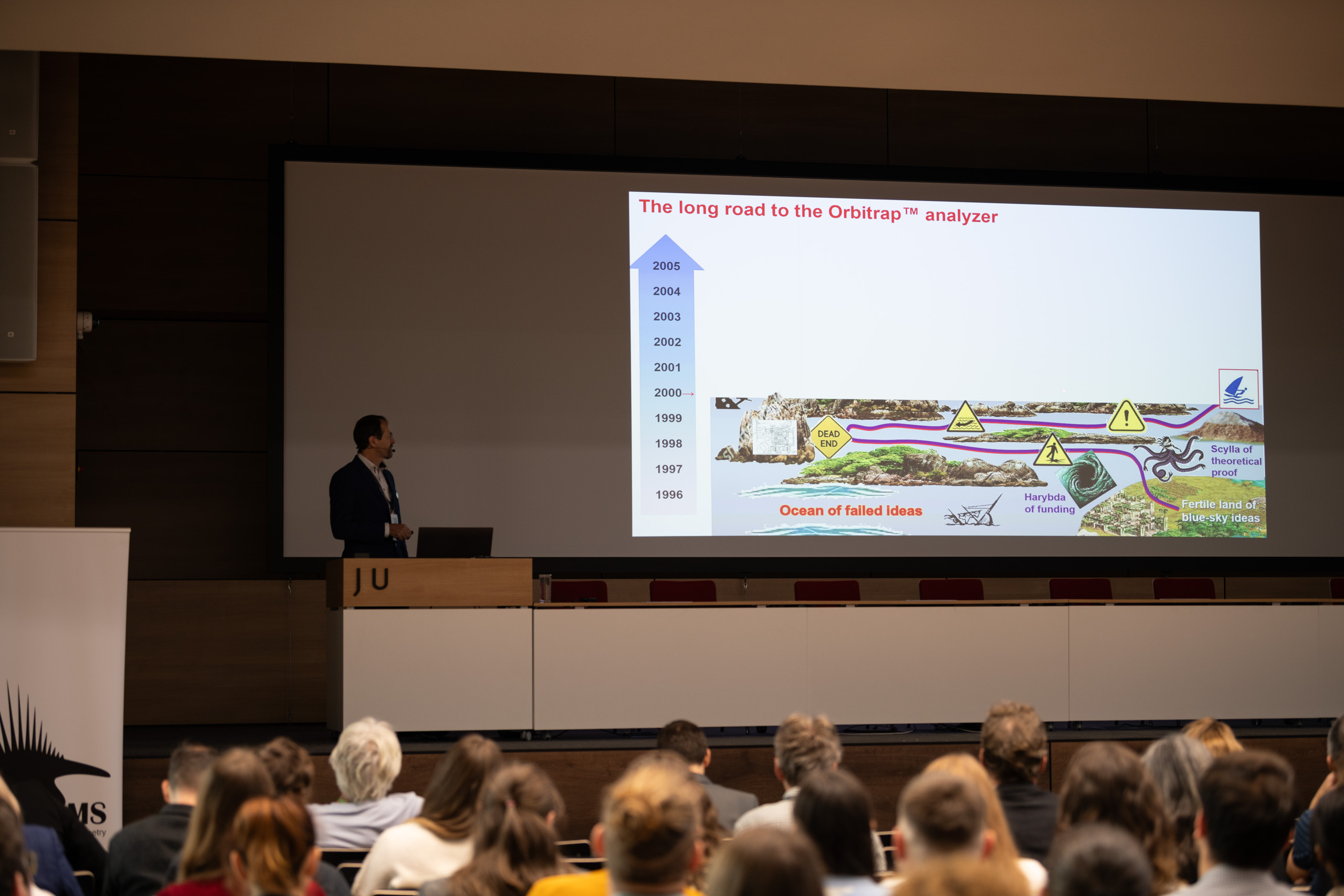
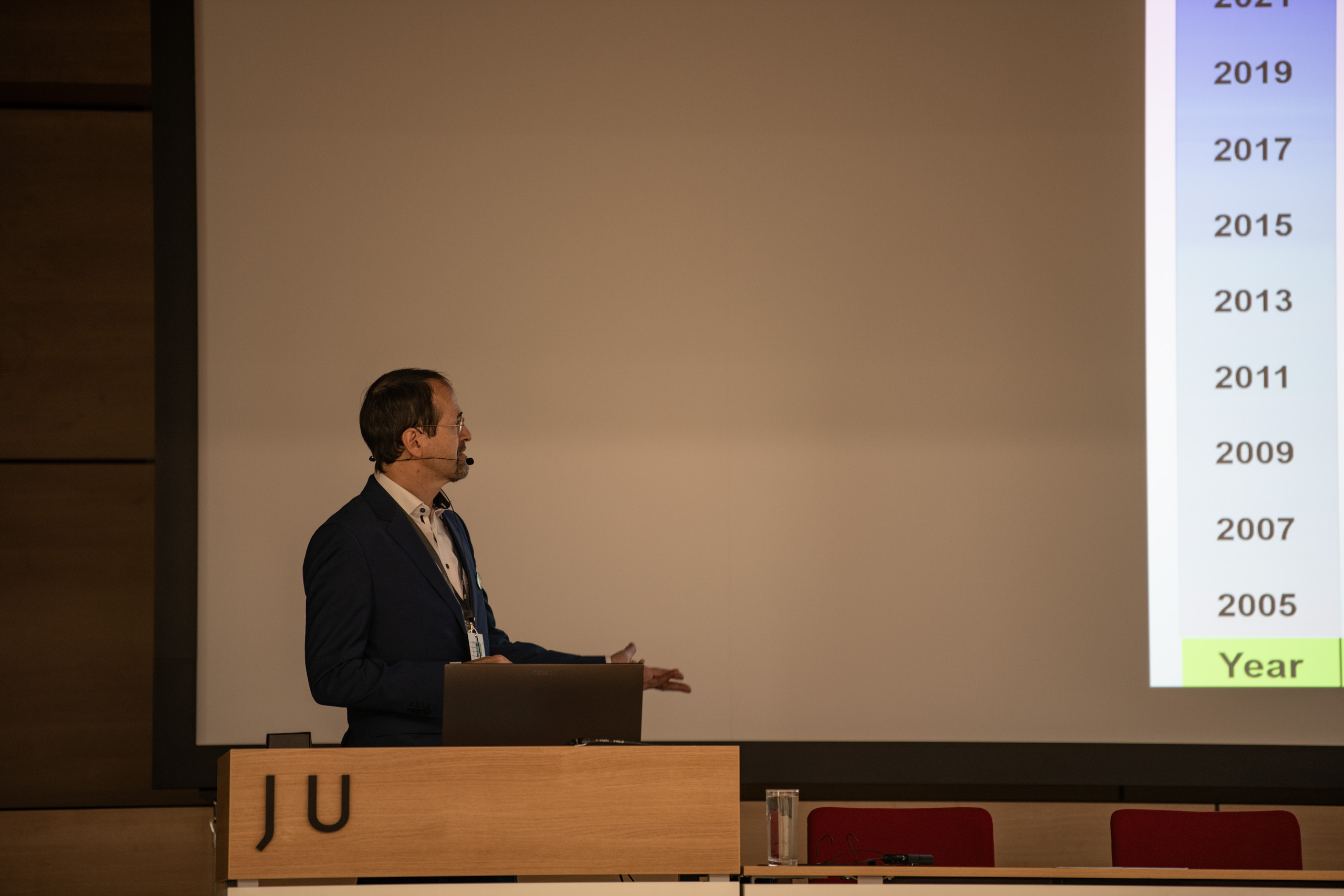
On 19-21 November, the 13th International Conference of the Czech Society for Mass Spectrometry and 11. Informal Proteomics Meeting took place in the Auditorium of the University of South Bohemia in České Budějovice. The event was held in cooperation with the Biological Centre of the CAS, and the University of South Bohemia in České Budějovice, with the financial support of the South Bohemia Region and the City of České Budějovice.

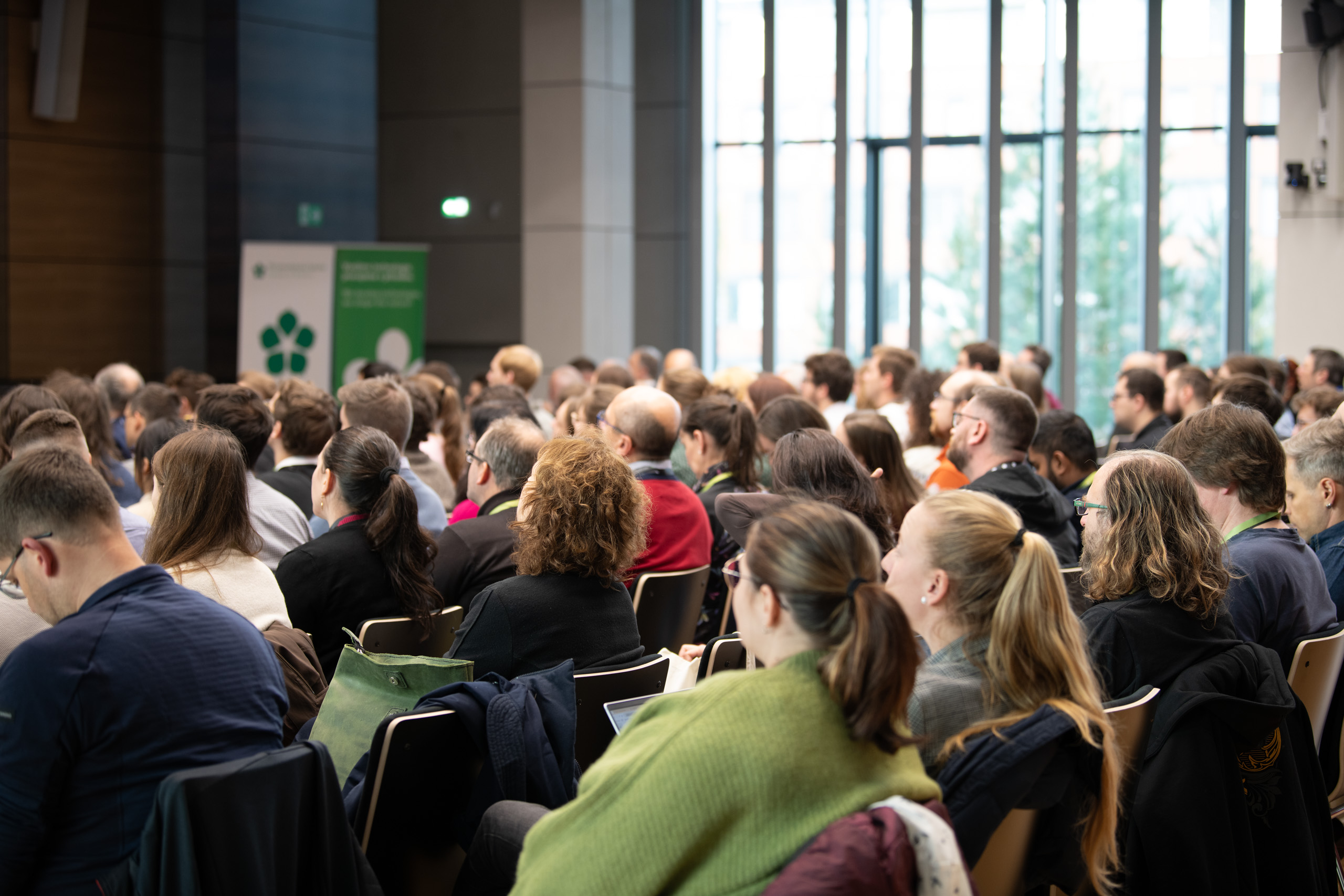
The conference attracted extraordinary interest of the professional community not only from the field of mass spectrometry. There were 195 registered participants, 23 lectures, 14 short talks, and 55 posters presented.

Among the highlights were plenary lectures by prominent figures of world science: Alexander Makarov (Thermo Fisher Scientific), Bernhard Küster (Technical University of Munich) and Jana Roithová (Radboud University). The programme was extremely busy throughout the three days and offered a wide range of topics from different branches of the field, from the study of small molecules to the analysis of huge protein complexes. The lively atmosphere fostered a number of inspiring discussions that highlighted new directions in mass spectrometry and stimulated mutual collaboration to address upcoming scientific challenges.

Finally, awards were presented for the excellent presentations presented during the conference. The award for the best short talk went to Federico Brigante from Tomáš Pluskal's group (IOCB). The Lenka Hernychová Award for the best poster went to Michaela Myšáková from Kristýna Gloc-Pimková's group (1st Faculty of Medicine, Charles University).

Defences and state exams Departmet of Chemistry 01 2025

BSc Biological Chemistry defences (EN)
Date: 14. 1. 2025, C6
 
8:00-8:45    Evaluating the potential for methane consumption by fungi. 
 
8:45-9:30    Temperature and irradiance growth optima of different Heterococcus (Xanthophyceae) strains. 
  
09:30-10:15 Vitality evaluation of cyanobacteria and microalgae in Arctic biological soil crusts winter conditions. 
 
10:15-11:00  Biocontrol of aphids. 
 
11:00-11:45  The evaluation of the protocol for the in vitro life cycle of zoonotic nematode Anisakis pegreffii and analysis of its morphological structure. 
  
12:45-13:30  Establishment of epigenetic CRISPR/Cas9 mutants of Arabidopsis thaliana. 
 
13:30-14:15  Immune responses of the red blood cells of the common carp Cyprinus carpio in the bacterial infection with Aeromonas hydrophila. 
 
14:15-15:00  Exploration of contamination in Mesodinium species and its impact on phylogenomic analysis. 
  
15:00-15:45 Effect of development deterring pheromone and population density on ladybird larvae. 

BSc Biological Chemistry state exams (EN)
Date: 30. 1. 2025, C1, C2, C4

Biochemistry, C4: 8:00, 8:30, 9:00, 9:30, 10:00, 10:30, 11:00, 11:30

Biology of Microorganisms, C1: 8:00, 8:30, 9:00, 9:30, 10:00, 11:00

Molecular Biology and Genetics, C2: 8:00, 8:30, 9:00, 9:30, 10:00, 10:30, 11:00

Biology of Animals, C1: 10:30


Obhajoby diplomových prací katedry chemie
Datum: 16.1. 2025, C3

13:30 – 14:20  Test toxicity vybraných antibiotic a produktů jejich fotochemické degradace vodní rostlině Lemna sp.

14:30 – 15:20  Test toxicity vybraných léčiv (diltiazem a warfarin) a směsí fotoproduktů jejich fotochemické degradace na Daphnia magna.

15:30 – 16:20  Stanovení kofeinu a jeho vybraných metabolitů pomocí HPLC/MS.

Defences and state exams Departmet of Chemistry 05-06 2024

Obhajoby bakalářských prací Katedra chemie /BSc theses defences

Datum konání/Date: 24. 5. 2024, Místo konání/Place: C 4

8:00 – 8:45                         Fluorescenční vlastnosti bilinových barviv a jejich komplexů s kovy

8:50 – 9:35                        Stanovení vybraných boswellových kyselin v pryskyřici kadidlovníku pravého a

                                              ve výrobcích z této pryskyřice metodou vysokoúčinné kapalinové chromatografie

                                              se spektrometrickou detekcí

9:40 – 10:25                       Kontrolovaná adsorpce antimikrobiálního enzyme na povrch plazmového polymeru

10:30 – 11:15                    Použití grafických softwarových nástrojů na zobrazování molekul, vzorců a grafů

                                               při výuce chemie na středních školách a gymnáziích

11:20 – 12:05                    Použití učebnic při výuce Chmei I (obecná a anorganická chemie) na středních

školách a gymnáziích     

13:05 – 13:50                    Optimalizace detekce sfRNA viru Klíšťové encefalitidy v RNA z hostitelských buněk pomocí hybridizačních technik

13:55 – 14:40                    Strukturní a biochemické porovnání C-terminálně zkrácených variant virového protein P4 z čeledi Cystoviridae

14:45 – 15:30                    Vliv očkovacích metod na kvalitu krystalů protein LinB32

15:35 – 16:20 Optimalizace metod transfekce genu pro NS2A viru klíšťové encefalitidy do neurálních buněk a imunodetekce jimi produkovaného protein NS2A

Obhajoby diplomových prací Katedra chemie /MSc theses defences

Datum konání/Date: 22. 5. 2024, Místo konáni/Place: C 4

8:00 – 8:50                         Stanovení obsahu PAU v cigaretových nedopalcích             

9:00 – 9:50                         Test toxicity vybraných fluorchinolonových antibiotik a reakčních směsí

po fotochemické degradaci těchto antibiotik na Daphnia sp.

10:00 – 10:50                    Vazby iontů kovů na fykocyanobilin a jeho estery                            

12:30 – 13:20                    Detection of intracellular H2O2 molecules using the genetically encoded fluorescent marker HyPer7


Bakalářské státnice/BSc Chemistry state exams 

Datum konání/Date: 30.5.2024, Místo konání/Place: C5, C6

Anorganická chemie/Inorganic chemistry, C6 13:30 -16:00

Biochemie/Biochemistry, C6 11:00-12:00

Organická chemie/Organic chemistry, C5 8:30 - 10:30

Magisterské státnice/MSc Chemistry state exams

Datum konání/ Date: 22.5.2024, Místo konání/Place: C4

Strukturní biochemie, Experimentální metody studia makromolekulárních látek,

Molekulární a buněčná biologie/ Structural biochemistry, Experimental methods for the study of macromolecular substances, Molecular and Cellular Biology – 13:30

Datum konání /Date: 23.5.2024,Místo konání/ Place: C4

Chemie a Didaktika chemie/ Chemistry and Didactics of Chemistry        8:00 – 8:50, 8:55 – 9:45, 9:50 - 10:40,10:45 – 11:35, 11:40 – 12:30 ,13:30 – 14:20,14:25 – 15:15, 15:20 – 16:10


BSc Biological Chemistry defences (EN)

Date: 12. 6. 2024, Place: C6

8:00-8:45   Elucidation of the function of Kap60 and Kap95 in the tRNA retrograde pathway in Trypanosoma brucei.

8:45-9:30   Immunometabolic Tumor Therapy.

09:30-10:15Cloning and Expression of two selected Antigenic Proteins and their characterization as diagnostic markers against Relapsing Fever Disease.

10:15-11:00Expression and purification of fibrinogen-related proteins from the soft tick Ornithodoros moubata. 

11:00-11:45Biochemical inhibition of ß-Glucosidase and Leucine-aminopeptidase. 

12:45-13:30 Study of Viral Protein Complexes using Mass Spectrometry.

13:30-14:15 Impact of Trypanosoma brucei MICOS subunits on cristae morphology.

14:15-15:00 Genome size stability of dried tissues of selected genera of ferns and lycophytes.

15:00-15:45Potential antiviral effect ofa-spinasterol against tick-borne encephalitis virus.

15:45-16:30 Seasonal occurrence of picoplanktonic cyanobacteria in water treatment plant Milence and their application in nanobiotechnology.

BSc Biological Chemistry state exams (EN)

Date: 21. 6. 2024

Biochemistry, O100 8:00, 8:30, 9:00, 9:30, 10:00, 10:30, 11:00, 11:30, 13:30, 14:00, 14:30, 15:00,15:30, 16:00

Biology of Microorganisms, O101 8:00, 8:30, 9:00, 9:30, 10:00, 10:30, 11:00, 11:30, 13:30, 14:00, 14:30, 15:00,15:30, 16:00

Molecular Biology and Genetics, O108/O113 8:00, 8:30, 9:00, 9:30, 10:00, 10:30, 11:00, 11:30, 13:30, 14:00, 14:30, 15:00,15:30, 16:00

Defences and state exams Departmet of Chemistry 09 2024

BSc Biological Chemistry defences (EN)

Date: 17. 9. 2024, Place: 009/dean’s meeting room

8:00-8:45       Chromosomal sex determination of Fukomys mechowii.

8:45-9:30       Water isotopes in dissolved organic matter: the interface of isotope

hydrology and organic geochemistry.

09:30-10:15   Seasonal occurrence of picocyanobacteria in water treatment plant

Kutná Hora and their utilisation of phosphorus and iron.

10:15-11:00    Submitochondrial localisation of putative Oxa1 homologs in Trypanosoma

bruceiusing newly raised antibodies.

11:00-11:45    Assaying the expression levels of Erk1and Erk2mitogen-activated-kinase,

and Btbdl8gene mRNAs in various stages of preimplantation mouse embryo development.

12:45-13:30    Assaying the inter-cell heterogenous formation of intermediate filaments

(specifically the KRT8 protein) in the development of the preimplantation mouse embryo.

13:30-14:15    Cloning and Expression of two selected Antigenic Proteins and their

characterization as diagnostic markers against Relapsing Fever Disease.

14:15-15:00     Aging-associated changes in the experssion of epigenetic factors and their impact

on longevity in mammals.

15:00-15:45     Activity of Dnmt3lgene in guinea pig oocytes.


BSc Biological Chemistry state exams (EN)

Date: 19.9. 2024, C1, C3, C4

Biochemistry, C4: 8:00, 8:30, 9:00, 9:30, 10:00, 10:30, 11:00, 11:30, 13:00,13:30, 14:00, 14:30, 15:00,15:30, 16:00, 16:30, 17:00

Biology of Microorganisms, C1: 8:00, 8:30, 9:00, 9:30, 10:00, 11:00, 11:30, 13:00, 13:30, 14:00, 14:30, 15:00,15:30, 16:00, 16:30, 17:00

Molecular Biology and Genetics, C3: 8:00, 8:30, 9:00, 9:30, 10:00, 10:30, 11:00, 11:30, 13:00, 13:30, 14:00, 14:30, 15:00,15:30, 16:00, 16:30, 17:00

Biology of Plants, C1: 10:30

Date: 20.9.2024, C4

Biochemistry, C4: 8:00, 8:30, 9:00, 9:30, 10:00, 10:30, 11:00

Defences and state exams in January 2026

  • Seznam štítků: Obhajoby

Defenses of bachelor's theses (Biologocial chemistry)

21.1. 2025

C5

12:00-15:30

Defenses of master's theses (Biologocial chemistry)

20.1. 2025

C5

10:00 - 10:50 Quantification of Oxo-Acids of the Human Metalobome 
Using Liquid Chromatography Mass-Spectrometry

12:20 - 13:10 Exploring the Interaction Between Biomolecules and Crowding 
Agents through Molecular Simulations

MSc. State final examinations (Biologocial chemistry)

20.1. 2025

C5

10:50 - 11:35

13:10 - 13:55

BSc. State final examinations (Biologocial chemistry)

27.1. 2025

B4, B5, B6

12:00-15:30

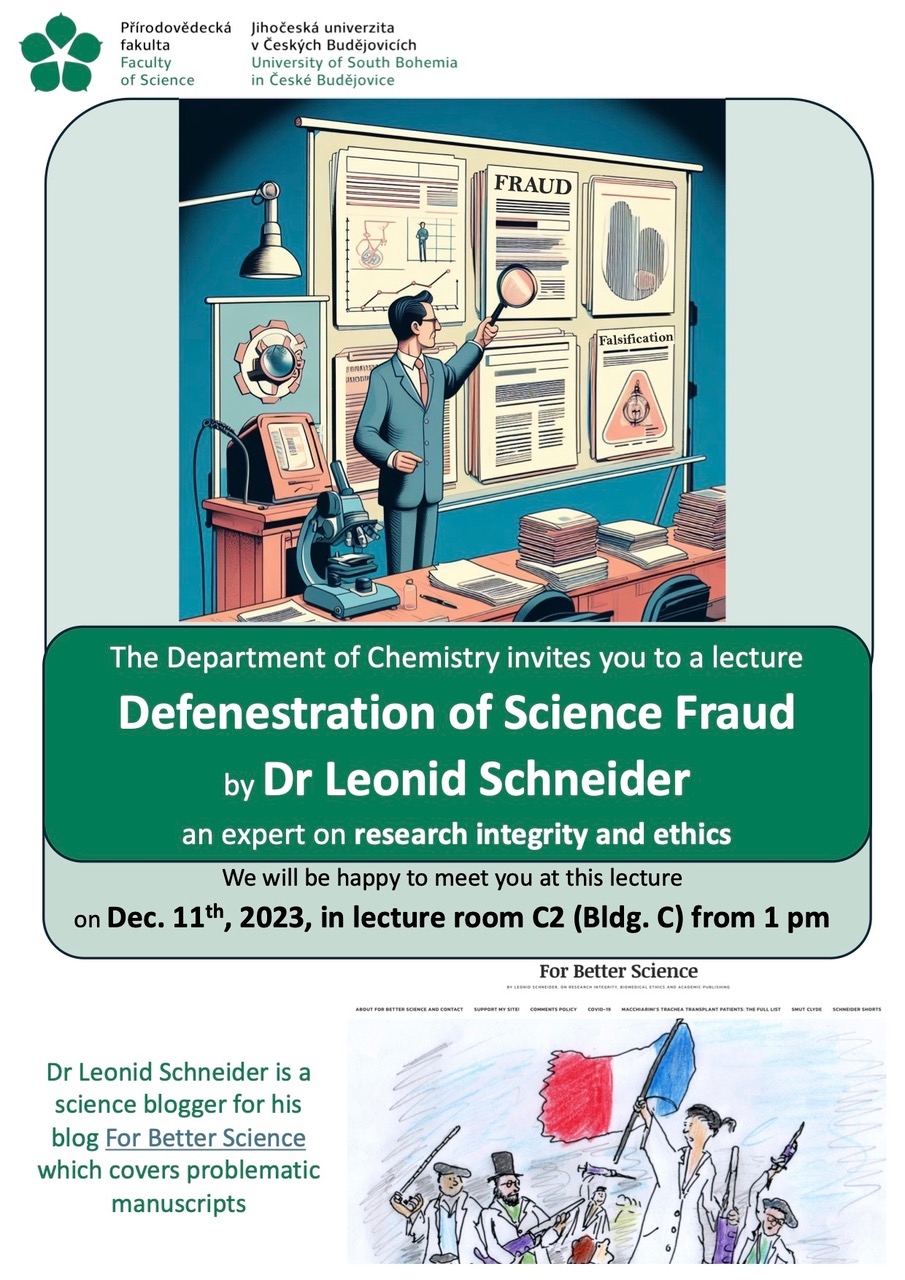
Defenestration od Science Fraud lecture 11. 12. 2023 1 pm + link

Lecture Defenestration of Science Fraud by Dr Leonid Schneider, Mon Dec 11th, 2023, 1 pm

Dear Colleagues,
 
We cordially invite you to a lecture on "Defenestration of Science Fraud" by Dr Leonid Schneider, a leading expert on scientific ethics. The lecture will focus on key aspects of ethics in scientific research and provide insight into current challenges in the areas of scientific integrity, detection of falsified data and plagiarism in scientific publications, and is a unique opportunity for scientists, educators and students to hear from this prominent figure in scientific ethics.
 
Date and time: 11 December 2023 13:00
Venue: room C2 (building C)
 
 
For more information about Dr. Leonid Schneider and his work, visit his blog For Better Science.
 
We look forward to seeing you at this interesting lecture.
 
Sincerely,
David Bína and Ján Štěrba.
 

Přihlaste si
odběr newsletteru

Zůstaňme v kontaktu na
sociálních sítích

Branišovská 1645/31a, 370 05 České Budějovice Tel. 387 776 201 | Tato e-mailová adresa je chráněna před spamboty. Pro její zobrazení musíte mít povolen Javascript.

Branišovská 1645/31a, 370 05 České BudějoviceTel. 387 776 201 | Tato e-mailová adresa je chráněna před spamboty. Pro její zobrazení musíte mít povolen Javascript.

© 2026 Jihočeská univerzita v Českých Budějovicích
Cookies

1

0